Unknown's avatar

Kilisët Violet Marie Gellenbeck

In 2017 Creekstone Press joined forces with a truth and reconciliation project already well underway. The book that became Shared Histories: Witsuwit’en-Settler Relations in Smithers, British Columbia, 1913-1973, focused on the story of Indiantown, a small community on the edge of Smithers where Witsuwit’en families tried to make a place for themselves in spite of systemic racist opposition. In 2010s both Witsuwit’en and longtime settlers formed a working group to bring their stories to light and consult with the young geography professor who authored the book, a Smithers man who grew up in the subdivision built after the erasure of Indiantown. The consultation was thorough, demanding and fraught with difficulty. There were times I thought the book was never going to be finished. But it was, and we launched it with a march from Smithers to Witset (the closest Wet’suwet’en community) and a feast welcoming over 200 people from the settler community in September 2018

Many good people shared their often painful stories and worked across cultural misunderstandings to bring this book to fruition. Witsuwit’en sisters Violet Gellenbeck and Charlotte Euverman were especially helpful to me as I struggled with the project’s complexity. It was heartbreaking to hear of Violet’s death on Jan. 4. Tyler McCreary, the geographer whose name is on the cover of Shared Histories, wrote this eulogy for her funeral held January 11 in Witset. In it he encapsulates her life’s joy and heartbreak, and her commitment to the long struggle to enable Indigenous people to live peaceably in their territories. The photograph below shows her welcoming the marchers to Witset.


On January 4, 2024, Violet Gellenbeck died peacefully in her home at the age of 86. A matriarch within the Wit’suwit’en community, she will be remembered for her dedication to the cause of Indigenous peoples. Over her life, she made countless contributions to advancing Indigenous concerns, including in Native education and employment services, Witsuwit’en language and cultural revitalization, protection of Indigenous women and girls, and defence of Witsuwit’en yintah.

Born on September 1, 1937, Violet descended from the proud lineage of Kwin Begh Yikh within the Likhsilyu. Her maternal grandmother, Mary Mooseskin, belonged to a chiefly family; Mary’s brothers Round Lake Tommy and Louie Tommy carried the name Ut’akhkw’its. Violet’s mother, Lucy Bazil-Verigin, took the name Gguhe’ at 12 years of age, and upheld that name through her life.

Violet was also born in a time of turbulence and change. Attempting to adapt of the lifestyles of the newcomers, her uncles had built a farm on Kwin Begh Yikh territories by Round Lake. However, settlers coveted the land and racist land policies in the period prioritized the rights of immigrants over Indigenous peoples. Displaced from those lands, Ut’akhkw’its Round Lake Tommy would establish another home at Johnson Lake, while Louie Tommy and his siblings Jack Joseph and Eva Isadore would become among the founders of the Indiantown community alongside Smithers. Violet’s grandmother Mary Mooseskin and grandfather Mooseskin Jim became part of a Witsuwit’en community on Buck Flats adjacent to Houston.

While the arrival of settlers had dramatic impacts on Kwin Begh Yikh, house members nonetheless sought to integrate into the emerging economy. Violet was born at Beamont, a camp in the Bulkley Canyon where Witsuwit’en workers cut poles for the railway. Her parents, Lucy and Frank Bazil, would move from Beamont to the community at Buck Flats, then Indiantown, and a series of rental houses around Smithers before eventually purchasing their own home on Railway Avenue.

While the Bazils lived on Witsuwit’en territories, and attended the balhats in Witset, they remained distinct from the reserve community during these years. In 1946, the family was enfranchised, taking away their Indian Status. Both Frank and Lucy had attended Lejac Indian Residential School and experienced the traumatic impacts of assimilationist government schooling. Conditions there were atrocious. Two of Frank’s siblings, Mary and Agnus, died in the residential schools. Enfranchised children were able to attend public schools, protecting them from conditions at residential schools, but it also meant that the family was no longer allowed to stay on reserve or access band services.

Violet was one of the first Witsuwit’en students to attend public school in the Bulkley Valley. Starting school in Houston and continuing at Muheim in Smithers, she developed a lifelong love of learning. She held fond memories of school. Education broadened her horizons and opened new possibilities for the future. Violet dreamed of being a nurse.

However, family circumstances intervened. The family did not have access to Indian health services, and medical debts had accumulated. The first of 14 children, Violet had to leave school to help support the family. Violet took a job at Sacred Heart Hospital in Smithers. She had reached Grade 7.

Sacred Heart Hospital would introduce Violet to the great love of her life, Werner Gellenbeck. Werner was born in 1933, the child of a miner in Gladbeck, Germany. He migrated to Canada in search of industrial work, which he found in Northern British Columbia. An accident brought him to the hospital. With an injured hand, he needed Violet’s help to cut up his food.

This chance encounter slowly developed into a love. It was, in many ways, an unexpected romance fostered with the unlikely assistance of the hospital priest, Father Godfrey. Werner, a recent German immigrant, did not speak English well. So, he wrote letters, in German, which Father Godfrey then translated to Violet, continually admonishing that he was not an appropriate man for her to date. Violet listened to the warmth of Werner’s words and ignored the old priest.

Dating Werner, Violet charted her own path. Her parents had been planning an arranged marriage to, in Violet’s words, an “old guy.” Always independent, Violet found her own love in the young Werner. In 1953, they moved to Prince Rupert together.

Prince Rupert were the happiest years of Violet’s life. She married Werner in 1955. They had three children in Prince Rupert: Bernie in 1956, Ingrid in 1958, and Gordon in 1962. Violet worked in the salmon canneries, Werner in the pulp mill. Initially, they lived in a two-room cabin, but over time they saved up money and bought a bigger, two-story, three-bedroom home. As a parent, she always emphasized the value of training and hard work, setting a model for her children.

In 1966, they took their first vacation, travelling south and visiting Bellingham, Vancouver, Victoria, and Port Alberni. They loved the island and decided to move, finding an old house in Ladysmith built in 1906. They lived there from 1966 until 1971.

On Vancouver Island, Violet returned to her long-delayed dream of education. In 1968 and 1969 she took the practical nursing program in Nanaimo and did a practicum at Duncan General Hospital. She then went on to work at Ladysmith Hospital in 1969 and Saltair Hospital in 1970.

In this period, Violet also began to get politically involved. In 1969, she began to attend meetings of the British Columbia Association of Non-Status Indians (BCANSI). Legal enfranchisement had deprived non-Status Indians of accessing rights under the Indian Act, including reserve residence and band services and funding. However, non-Status Indians continued to suffer from poverty and discrimination. BCANSI sought to improve access to education and employment, as well as fight discrimination in the Indian services. Violet participated in these campaigns and began public speaking on these issues.

In the fall of 1971, the Gellenbeck family relocated to Terrace. Violet continued organizing with BCANSI and also became involved with another Indigenous rights organization, the Union of Native Nations (UNN). She was a founder of the Kermode Indian Friendship Center in Terrace, serving as organization president for several years.

Living in the North, Violet was able to become more involved in traditional governance in the bahlats. Taking greater duties within the Kwin Begh Yikh, Violet took the name of Ghukelen in 1974. She was also connected to traditional foods, preserving salmon and making medicinal teas. A great cook, she intermixed Witsuwit’en and German dishes, making fantastic fusion foods.

Tragically, through these years, Werner struggled with addiction. This eventually led to his premature death in 1980. His loss was a sadness that Violet would carry through the rest of her life.

She channeled her love into work to improve the lives of others. She took a position with Canada Manpower in 1979, working as a Native employment specialist. In 1983, she took a promotion and relocated to Vancouver to expand the scope of her work. However, life in Vancouver was isolating; after three years, Violet took a demotion in order to move to Kelowna where she could be with her daughter Ingrid.

Following the organizing of BCANSI and UNN and other groups, the Canadian government revised the Indian Act, enabling disenfranchised families to regain their status. In 1986, Violet got her status back. This allowed her to live and work on reserve. Subsequently, she decided to move to Witset in 1988.

She took a position as Moricetown Band Manager. Violet wanted to bring the knowledge that she gained working for Canada Manpower to support the Witsuwit’en community. While she was a strong leader with passion for the role, it was not the right time in the community for her style of leadership and she left the band office. Later she took a position with the Gitksan-Wet’suwet’en Government Commission, directing economic development initiatives for the eight member bands.

She remained an active member of the Witset community. She was a consistent defender of band members, particularly vulnerable women and children, helping ensure that the community was a safe space.

Simultaneously, she was involved in major Aboriginal title litigation that would transform Canadian and international conversations about Indigenous rights. Through the late 1980s and early 1990s, the Witsuwit’en hereditary chiefs, alongside their Gitxsan neighbors, took the government to court claiming unceded ownership and jurisdiction over their traditional territories. The case was known as Delgamuukw, Gisday’wa, named after the lead Gitxsan and Witsuwit’en plaintiffs. Delgamuukw, Gisday’wa advanced the hereditary chiefs’ claims on the basis of Indigenous legal traditions.

In the case, hereditary chiefs took the stand as experts on their own legal traditions. Violet’s mother, Gguhe’ Lucy Bazil, was one of the Witsuwit’en witnesses and Violet played a vital role in supporting her. The Delgamuukw, Gisday’wa case radically transformed Aboriginal policy in Canada and led to modern treaty negotiations.

In 1993, the Gitxsan and Witsuwit’en hereditary chiefs split into two organizations to negotiate their respective claims. Violet served as Executive Director of the Office of Wet’suwet’en, working closely with and taking guidance from hereditary chiefs such as Gisdaywa Alfred Joseph, and Wigetimschol Dan Michel, and Sats’an Herb George. Later she would serve as chairperson of treaty negotiations for four years.

The treaty negotiation process stalled due to a government treaty framework that aimed to force Indigenous peoples to abandon their responsibilities for the majority of their territories. The Witsuwit’en hereditary chiefs were adamant that reconciliation was not just about money. It required negotiating a shared land management process that recognized the chiefs’ responsibilities in stewarding the yintah.

Stepping back from the treaty process, Violet focused on caring for her aging mother, Gguhe’ Lucy Bazil-Verigin, and helping preserve her knowledge and teachings for future generations. She remained active in traditional governance through the bahlats. After the passing of her mother’s cousin Eva Isadore, Violet took her name, Kilisët, in 1990. She carried that name with honour. She also supported others. A skilled seamstress, she made regalia for other chiefs, including Lho’imggin Alphonse Gagnon and Wigidimst’ol Dan Michel. She preserved traditional medicines and continued to learn new skills, like Tlingit weaving.

Although Kilisët retired from the workforce, she never stopped contributing to the community. She was an active researcher collaborating in numerous projects. She helped establish the Witsuwit’en Culture and Language Society, working with the Bulkley Valley School District to create Witsuwit’en curriculum. She collaborated with anthropologist Melanie Morin in the creation of Niwhts’ide’nï Hibi’it’ën: The Ways of Our Ancestors, a textbook introducing students to Witsuwit’en people and their history. She guided geographer Tyler McCreary in his research for Shared Histories: Witsuwit’en-Settler Relations in Smithers, British Columbia, 1913-1973, a book that acknowledged the history of Witsuwit’en families in Indiantown. She worked with linguist Sharon Hargus to publish Witsuwit’en Hibikinic, a Witsuwit’en-English dictionary. 

Kilisët continued working on Witsuwit’en language and cultural revitalization projects until her final days. For the last year and half of her life, Kilisët advised UBC PhD student, Sarah Panofsky, on the project “Ts’ienï Kwin Ghinen Dïlh (Everyone Coming Back Home to the Fireside).” In the project, she guided and mentored a research circle of Witsuwit’en hereditary chiefs, frontline workers, and social service leaders. “Ts’ienï Kwin Ghinen Dïlh” renews and develops distinctly Witsuwit’en approaches to caring for vulnerable children and families, helping facilitate the exercise of Witsuwit’en jurisdiction over child welfare. She also sought to reintegrate families disrupted by the intergenerational effects of residential schools and the foster care system. She described the work as dedicated to “those people, children growing up that are lost out there, just to bring them back to the point of knowing who they are.”

Kilisët was a consistent and powerful voice for Witsuwit’en and other Indigenous peoples. She had friends across the Northwest, including among the Carrier Sekani, Gitxsan, Haida, Nisga’a, Tsimshian, and Tlingit. She also worked to build bridges with the settler community, sharing Witsuwit’en traditions with them and always eagerly learning lessons about the different cultures of immigrants to the yintah.

Through her life, Kilisët was an advocate for those at the margins, such as the unemployed, women, and children. The legacy she leaves us is one of deep commitment to upholding Witsuwit’en traditions and laws. She was persistent, some might even say stubborn. She fought for things to happen in the right way, according to inuk’ niwh i’t’en. But her actions were guided by her love and respect to each person’s fundamental human dignity. Let us grieve her loss but also never forget her. Let us use her life as a lesson for how we conduct ourselves. Violet always said it best. Let her words be a message to guide us into the future.

Today as we work together, we’re not making things up new to teach our people. What we’re doing today is we’re following the knowledge passed down to us from our ancestors and we’re making it stronger so that our Nation becomes stronger.

Let’s come back together because this work that we’re doing is very important. It’s not for us, it’s not for us to use in the future. But it’s for our children, for our children’s children—your grandchildren, their children—your great grandchildren, and those babies not yet born, that’s who you’re working for. That’s who you are going to leave the yintah to.

Unknown's avatar

Finally, rain.


We’ve been away, dodging in and out of heat and smoke, mostly lucky. Just days before we left on August 1, we sent off the proofs for Creekstone Press’ latest book, Shared Histories: Witsuwit’en – Settler Relations in Smithers 1913 -1973 by Tyler McCreary. As we drive south, I imagine huge scrolls of paper (I grew up in a paper mill town and that’s where we’re headed), massive rollers turning, long blades slicing through the bleeds at the edges of some pages.

Smoke between Fraser Lake and Vanderhoof, fires north and south. Afternoon sun scorching the high rises along the Fraser River in New Westminster. The relief of a swim off Grief Point in Powell River, my 94-year old mother joining us.

The bright book cover printed and cut; a glossy skin protecting its images, the kind words on the back. The glue along the spine.

Our son’s wedding on his grandmother’s lawn, the smoke already rolling in to erase the islands just offshore, the mountains behind Courtenay. Hanging on for days.

When we finally head north again, we hear the book has been shipped. And, for the first time in a month, rain. The Fraser Valley wet. The Fraser Canyon, damp. Further north, back into the smoke. A pale blue haze shimmering in the distance.

Again, between Prince George and Burns Lake, brutal smoke. No rain here. Sore throat, irritated eyes and those poor residents have been inhaling this for weeks now.

Home and the books have arrived. Carton after carton of stories, analysis, old photos and maps. A great sigh of first relief, then pleasure.

The ground has sucked in its cheeks around the shrunken stems of fireweed, nettles, and cow parsnip.  Cottonwood leaves, open palms on the ground, scarred by the leaf miners’ sad stories. We walk up the Malkow Lookout trail, our footsteps puffing up clouds of dust. The cows watch us pass, their cow pies already flat plates, dry on the desiccated grass. A few asters in shaded spots, nothing else in bloom. The bush is loud with the hum of bees. Everything is speckled with aphids, shining with honeydew. Some leaves are shellacked, others sticky. And this, I find, is nectar for bees.

We hear chickadees, juncos and kinglets. See one flock of robins startled up out of the field. Five water bombers pass overhead, one, two, three, four, five. Heading toward Babine Lake.

The saskatoon berries are desiccated, the cranberries few, the wild raspberries hiding in the shade. Our own grass is sparse, soil showing through at the crest of every downhill slope.


And then, tonight. Standing outside in the suddenly early darkness. Finally. Rain.


Unknown's avatar

Everything connects…

Creekstone Press

We are very proud to be celebrating Creekstone Press’s 20th anniversary this year. We began by publishing my book, Canyon Creek: A Script – a book about the eviction of a Witsuwit’en family from its homesite on the Telkwa Highroad in the 1920s. We’ve published about one book a year since then and we have two more in the works. Last year, Neil Sterritt’s Mapping My Way Home: A Gitxsan History – with local design and cartography – won the Roderick Haig-Brown regional prize, a prize awarded for a book that contributes to the enjoyment and understanding of BC; it also took second prize at the BC Historical Federation’s book awards. And one of our other authors, Sarah de Leeuw, who wrote Front Lines: Portraits of Caregivers in Northern BC, is also up for an award for her collection of essays, Where it Hurts. Both Neil and Sarah have been guests on In the Shadow of the Mountain and their interviews can be accessed via CICK’s website.  Other guests who have been on the show nominated for prizes this year include Eden Robinson who’s been nominated for the Ethel Wilson fiction prize for Son of a Trickster; Theresa Kishkan nominated for the Hubert Evans non-fiction prize for Euclid’s Orchard & Other Essays. Our second book, Oar and Sail: An Odyssey of the West Coast by Kenneth Leighton, which was short-listed for a prize back in 2000 – is excerpted in Spindrift: A Canadian Book of the Sea, another short-listed book.

In the Shadow of the Mountain

While Creekstone Press continues its work, I’m ready to shift directions and leave In the Shadow of the Mountain. It’s been almost four years and over 50 shows and has given me a wonderful opportunity to connect with other writers, to give me both the motivation and excuse to just talk to other writers about writing. But it takes time away from my own writing, which each of my conversations on In the Shadow of the Mountain makes me miss even more.

I’d like to share some of thoughts about leaving.

Yesterday I broadcast my final edition of In the Shadow of the Mountain on Smithers Community Radio Thanks to the wonderful staff and volunteers at CICK 93.9 FM for helping out with the show and for all the other shows they make, the community events they present, and the community connections they foster. And thanks, as well, to Interior Stationery and Books/Speedee Interior Stationery and Books/Speedee Mills and Books on Smithers’ Main Street – for sponsoring the show and for keeping us in good reads. Bravo!

I was especially pleased that my final guest for In the Shadow of the Mountain was Donna Kane, a writer from the Peace River country, Rolla to be exact. Donna was a guest on the show many times – she did a regular writing gossip column in its first year and I also did a show with her about her chapbook Pioneer 10: I Hear You.  She’s published two books of poetry, organized innumerable poetry readings and writers’ camps, including several in the Muskwa Kechika where her husband, photographer Wayne Sawchuk, takes summer-long horse trips every year in order to draw attention to some of the last remaining wilderness in the Northern Rockies. I had the pleasure of spending a couple of weeks at an artists camp there a few  years ago and created a series of images and poems called The Muskwa-Kechika Fire Poems.

It’s no surprise that Donna’s latest book is called The Summer of the Horse. What surprised me is that it’s not poetry, but rather a memoir of sorts. It documents the day she and Wayne met at a book fair, each of them having grown up almost next door to each other without ever meeting, each in long term relationships; they are instantly drawn each other. In the book, Donna documents the changes their relationship precipitated, the pain and uncertainty it caused, and the questions it led her to explore: the ways in which our thoughts, our observations and our actions are inextricably connected. To quote poet Lorna Crozier, “It’s a love story, not only between a remarkable man and an equally remarkable woman, but between this same woman and horses, this same woman and the BC wilderness. There is such fine thinking between these pages that could only have been written by a poet/philosopher. By someone who opens her mind and body to the beauties and sorrows that surround her and who finds the words to knot everything together with such finesse they’ll never come apart.”


Unknown's avatar

A wonderful community

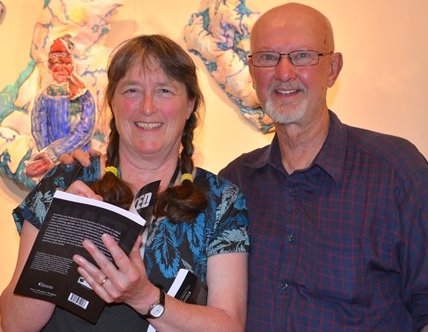
group with sheila

Shafted: A Mystery launch at the Smithers Art Gallery, Friday, Aug. 15, 2014

In his song, Well May the World Go, Pete Seeger says, “Find a part of the world that you really like and stick to it.” Sometimes it’s tempting to move south, to go back to the coast, to start somewhere completely new. But not last Friday evening when we gathered to celebrate the launch of my latest book, Shafted: A Mystery.

It was so warm, we opened every window and door in the art gallery. Forests to the south and east were on fire and the main highway was closed. People were stocking up on gas and groceries, worried about cell phone service and hydro lines.

When the back country is burning, setting out chairs for a book launch feels frivolous. As people walk out into the warm evening, the sky tinged with smoke, they are worried about the mountain goats living on the mountain that’s on fire, the cattle that graze in the bush, the travellers who can’t get home. We all know someone who’s fighting the spread of flames through the dead pines: dispatching, dropping fire retardant, struggling through the smoke, hauling hoses, cutting firebreaks. People are talking about it as they come in the door. A few drops of rain splatter the sidewalk and we all feel hopeful.

Friends are the first to arrive, bringing plates of beautiful snacks. Karen sets out cherry tarts made with her own cherries; Tonja has made amazing pinwheel sandwiches; Vigil has a dish of bruschetta; Kim brings cinnamon bread. Gail has food and flowers. Pat, as always, takes pictures. A bright punch fills a glass bowl and soon people are drinking and eating and visiting. Dorothy’s cello thrums deep notes below the voices.

perry and dorothy

Dorothy Giesbrecht and Perry Rath

A book launch in a town where you’ve lived for years, a town where the novel you’re launching is set, and a town with gardens full of food and flowers, is a wonderful thing. I love the conversations with people as they bring me books to sign: some are close friends, some are acquaintances I’ve known since I moved here, some are people I haven’t talked to in years. Newcomers. Visitors.

sheila and the haines

Peter Haines, Sheila, and Paulie Haines

richard, mike and harry 1

Mike Shervill, Richard Overstall and Harry Kruisselbrink

It’s wonderful to read aloud something you’ve written in solitude, to hear people fall silent, become attentive, enter into a story and laugh in recognition of a time, a place, a feeling that is home. It is wonderful to be able thank the people who helped bring the book together in a room filled with their friends and acquaintances.

But what goes deeper than that is the sound of a room full of people on a Friday evening telling each other their own stories, sharing their news, making plans, offering to help, making suggestions, hugging and laughing—in other words, doing many of the things that knit a community together.

Writers want their work to contain something of the universal, we want it to speak to people who don’t know us or where we live. But it is a great privilege to have created a sense of a place, a time, and people that in some small way reflect a community back to itself, a community you call home.

sheila and lynn

Sheila Peters and Lynn Shervill


We talk as we wash the glasses, sweep the floor and pack away the tables and chairs. These are good friends who have done worked together for years. In small towns, you have to create the events you want to attend. We have become skilled at this, we move in and out of groups that form and dissolve around issues, creative processes and political action, sometimes all at once. We ebb and flow with and among each other.


We consider ourselves lucky. We ‘ve found a place we love and we’re sticking with it.

Unknown's avatar

Nuchatlitz

We recently stayed in a cabin on a small unnamed island near Nuchatlitz, a former Nuchatlaht community off the west coast of Vancouver Island. The small island is privately owned by twelve people, but most of the surrounding area is either reserve or provincial park. We were there to kayak, but we were also visiting a place we’d read about. In 2001, our publishing company, Creekstone Press, reprinted John Gibson’s A Small and Charming World, a book first published in 1972 that told of Gibson’s time as a social worker in Smithers and later in Campbell River. The book’s last chapter contains a particularly poignant reference to Nuchatlitz.  At one time about 3000 people lived in the area, but when he flew in to pick up a little girl going to school in Campbell River, only five houses were occupied. When we were there, one unoccupied house remained and its last occupant, Lily Michael, was buried in the overgrown cemetery across the inlet. We so often think of these isolated places as wilderness, but they have been occupied for centuries, and contain many stories. Which is why writers look for places like this.

Virginia Woolf told us we needed a room of our own. In the Sea Watch cabin in Nuchatlitz, also known as Witt’s End, there are many rooms, each lined with books. Among those books, I found a collection of essays by E.B. White, The Second Tree from the Corner, in which he contrasts his writing practice to that of a contemporary who sits down at home where his “privacy is guarded” and works in an orderly and diligent manner to accomplish a great deal. White says that his “professional life has been a long, shameless exercise in avoidance.” His home is, he says, “designed for the maximum of interruption,” his office the place he never is. How can a writer not love E.B. White? How can a writer not love Witt’s End?

While each room has a table inviting the writer to sit down with a notebook, out the windows are sea otters, cedars, rhododendrons, driftwood installations, and a greedy young crow eating the salal berries growing out of one of those installations. And the books. Downstairs, Chinese literature, the classics, fiction, history, the restoration plays. Bill Kinsella, Margaret  Atwood, Virgil, A Dream of Red Mansions.

In the kitchen, beside the binoculars on the windowsill, the plant/bird/seashore/animal guidebooks.

You must climb the steep stairs to find the poets, ranged along the floor in a room with windows on three sides and skylights, a bed tucked into a dormer, the chimney from the wood stove below bringing warmth into its spaciousness. And a table, of course.

I brought a collection of Bruce Chatwin’s work along and, while it started well enough, seemed to become one of those publications designed to plump the coffers of his estate – some work would have been better left “unpublished or neglected.” In it he writes about the two towers where he writes well – one on the Welsh border and one in Tuscany. It is, he says, “a place where I have always worked clearheadedly and well, in winter and summer, by day or night – and the places you work well in are the places you love the most.”

Seawatch could become one of those places – and writer Paula Wild uses it for her own escapes and also runs writing retreats there. Shannon Bailey, the co-owner with Brian Witt, writes there too. She and Brian left Victoria (where she completed a Creative Writing degree at UVic) over a decade ago to live almost full time at Nuchatlitz. You really are a long way away from anywhere – an hour’s boat ride from Tahsis, which is about a three-hour drive from Campbell River.

You’d think it would be perfect. But the work to keep a place like Sea Watch running (solar energy, rain water cisterns, generators, boat maintenance and wild west coast weather) is, as White said, “designed for the maximum of interruption.” Like waiting for the right tides to put the sailboat up onto a neighbour’s makeshift dry-dock in order to scrape the barnacles off the hull, messy and physically demanding work, done in the dark, in the pouring rain. And anyone who’s lived in a place with only boat access knows the minutiae of hauling things up and down docks, in and out of boats, and offloading at a slippery low tide.

And then there are the distractions of all the artifacts the ocean offers up.  There are hundreds of installations in every available space, inside and out. Shells, skulls, feathers, tiny congregations in mossy corners, as well as the reminders of the many places Shannon and Brian have travelled.

The perfect retreat, I think, needs to be someone else’s tower – as Chatwin said. Where someone else is bringing in the groceries, doing the upkeep, weeding the gardens. Or, as I suggested to Shannon – a real winter. I always look forward to October here in Driftwood Canyon – dropping temperatures put a quick end to any silly notions about another crop of spinach, by November the snow covers all those projects that call for attention all spring and summer, and it’s dark so early and so late, you’re not distracted by the play of light on the trees. You leave the curtains open and stare out into the darkness, thinking.

This slideshow requires JavaScript.


Thanks to  Dan Shervill for letting me use some of his photos.