Thanks to Alan Pickard for sharing his research. Alan lived on the Telkwa Highroad for many years and has been researching its history for almost as long. Although he has returned to live in his home country of New Zealand, he visits regularly. He is writing a book he calls Place Name Stories Of The Bulkley Valley and the Driftwood name is one of the inclusions. This is what he has discovered.
Driftwood Creek, C’ide’Yikwah in Witsuwit’en, has its headwaters in the main, southwest facing basin of the Babine Mountains. It flows into the Bulkley River about 10 km down river from Smithers. Although driftwood collects in the beds of many rivers and creeks it remains unknown when the name Driftwood was given to this creek.
Only the Suskwa and Bulkley Rivers are shown on a 1866 Collins Telegraph map and documents. The Poudrier map of 1891 gives it the Witsuwit’en name Chi Noo A Kwa which must be what the surveyor Gauvreau heard during his walking survey through the Bulkley Valley in 1891; this presumably was a rendering of C’ide’Yiwah. Poudrier writes Big Rapid Creek in his 1892 survey field book for Driftwood Creek. Poudrier’s survey party met with some opposition from the First Nations people at Moricetown and they did not use First Nations people in their survey work. It seems Gauvreau used, or at least talked to at some length, First Nations people in 1891. Many of the details on Poudrier’s map of 1891 could only have come from Gauvreau.
A G [Father] Morice does not mention local creeks that cross the Telkwa High Road. It is most likely the name Driftwood Creek came from some of the pack-train or other travelers who passed through the Bulkley Valley from 1874 onwards. Camping places were most often beside creeks and these camping places were given local names, some of which will not have survived into the European settlement era. The name Driftwood Creek first appears in writing on J H Gray’s correctional survey field books for January 1906.
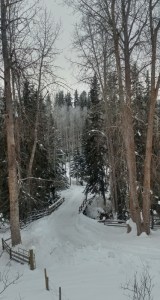
This crossing at the Nageli farm is just above the older one.
A bridge across Driftwood Creek is shown on J H Gray’s correctional survey field notes for 27 December 1906. This bridge is on Lot 844 on what was then the Hudson’s Bay Company ranch.* A 2 km road had been constructed on the true left of the creek from the Telegraph Trail crossing of Driftwood Creek to a place where a short log bridge could be put across using rocky banks on both sides. British Columbia Archives photo A-05288 dated 1905 is most likely the bridge across Driftwood Creek on Lot 844. Although there is a private farm bridge [the Nageli’s] at this location now, it was decided by the Highways Department that a bridge at the Lot 844 site would not be renewed in 1916. Therefore a bridge existed across Driftwood Creek on Lot 844 from 1905 to about 1916. It is unknown who took the 1905 photo and whether it is correctly dated. There was a photographer with the Provincial Mineralogist in 1905.

This early aerial photograph of what is now Eileen Shorter’s ranch shows the old king truss bridge over Driftwood Creek.
There is no mention of a bridge at the Telegraph Trail crossing (present Telkwa High Road) in any documents up to about 1916. Driftwood Creek is easy to ford at this point [just below Glenwood Hall] when the creek is not in flood. Many small bridges were built along the Hazelton to Aldermere trail/road from about 1905 onwards, and more and more money was spent on improvements of the road. Some King Truss bridges were built on this road from 1907 onwards. The problem for the Public Works Department, and later the Highways Department, was that the bridge on Lot 844 was on private land whereas the Telegraph Trail was a public right-of-way.
The name Telkwa High Road did not come into being officially until about 1920 although the name may have been locally used well before this. In the 1912-13 Public Works Report $761.35 was spent on the Driftwood Creek bridge but no specific location was given. It is likely this was the bridge on Lot 844.
In the 1919-20 Public Works Report $1,453.60 was spent on the Driftwood Creek bridge but no specific location was given. It is likely however that this was the bridge at the Telegraph Trail crossing, the present Telkwa High Road crossing.
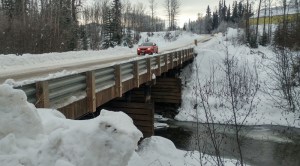
The current bridge below Glenwood Hall and Shorter’s ranch was installed after the 1986 flood.
The bridge across Driftwood Creek at the Telegraph Trail crossing (the present road crossing point) “went out some time ago”; this from a Highway Department letter dated 5 September 1936. This letter discusses at which of the two locations a replacement bridge should be built.
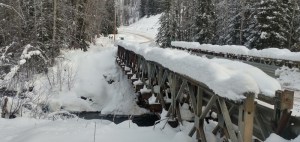
This is likely near the crossing referred to in the 1905 report. This bailey bridge just below Park Road on Driftwood Road was another replacement after the 1986 flood. In his history of the Babine Mountains, Joe L’Orsa said locals numbered the bridges consecutively above this one, which was adjacent to the Harvey homestead. The “fifth bridge” was at Sunny Point.
From the 1905 Provincial Mineralogist Report; “Babine Range, 17 September 1905, P. McPhee, a local prospector, engaged as guide. The trail up to these claims leaves the telegraph trail about half a mile west of Driftwood creek, and cutting across the rolling
hills through pea-vine and fire weed higher than the horses backs, crosses Driftwood creek about two miles up from the trail . . . The trail follows the east bank of Driftwood up for a couple of miles further, through heavy spruce woods, when it begins to climb
the main mountain side by a steep and poorly cut trail, through the small jack-pine and
balsam trees.”
It is said C G Harvey cut the trail to the Babines and staked the first claims in 1903, but
this date is doubtful. C G Harvey was given the Crown Grant for Lot 859 at Glentanna
in June 1906 and his son said C G Harvey came in to Hazelton in 1907. It is therefore
likely that Pat McPhee knew of the route/trail into the Babines via Driftwood Creek
before Harvey.
From a letter dated 30 April 1937 in the Smithers Highways Department files, “ . . . The
Dieter [road] grade running north is a revival of the old miner route . . .” although note
that the Provincial Mineralogist says the route started half a mile west of Driftwood
Creek, which means the trail started about six hundred meters north of present day
Gilbert Road.
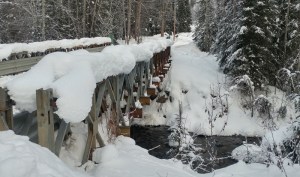
We always called this “the first bridge” – for many years after the 1986 flood there was no bridge here and access to the Babine Mountains was restricted to bike and foot traffic.
In the 1915-16 Public Works Report work was done on the Driftwood Creek Sleigh
Road; that is the road up Driftwood Creek. Four new bridges were built and a new
sleigh road. $1,696.30 was spent. In the report for the next year new work was done on
this sleigh road and $1,206.19 was spent.
The Interior News, 14 July 1920; A. P. McCabe returned to Smithers last week, having
completed the erection of five bridges on the existing route to the mining properties in
the Driftwood Creek section of the Babines . . . The crew on the bridges have been
turned over to Robert Mackin, who will extend the road for several miles as the
beginning of a truck line into the prominent claims of that district.

If the road accessing this bridge over Driftwood Creek on Snake Road is “less steep” than it used to be, it must have been very tricky in winter.
Driftwood Creek also is crossed by Snake Road. This road was first laid out in 1913. It is
unclear when the first bridge was built across Driftwood Creek on this road. In a letter
from the Department of Works dated 8 April 1921, a request for a “high level bridge over
Driftwood Creek on the Telkwa – Canyon Creek Road [Snake Road]” was turned down.
The road approaches to the crossing of Driftwood Creek on Snake Road were made less
steep in 1917. Snake Road was built about 1913.
*I’ll be writing more on this later.
I just had to add one more photograph of a Driftwood Creek bridge – the one currently providing access to the fossil beds at Driftwood Canyon Provincial Park. It is the fourth one built in the 40 years we’ve lived here.
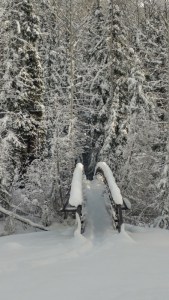


 Oh, it can be dark here in the canyon in December. Three hours of direct sunlight if we’re lucky. And cold. The solstice arrived with, finally, a dipper on the creek below the bridge up the road from our place. The one where the outlet of the ground water seeping out of Gordon Harvey’s old park enters the creek and makes an open spot even when everything is frozen. The old park where little bridges used to cross the creeklets trickling through tall spruce and cottonwood. A carved bear, long gone. A guest book anchored to a tree, also gone.
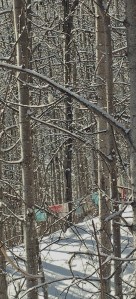 e solstice also brings a plane landing into the -14 winter evening. On it, our elder son and his fiance. Vancouver kids shivering in the cold. Life in the house doubles. That night, wolves howl nearby. It feels like a sign, a return of life and light. The next day, -20, we climb the hill and look for tracks. We don’t find them but we relish the sunlight as we look across the valley, its murky air.
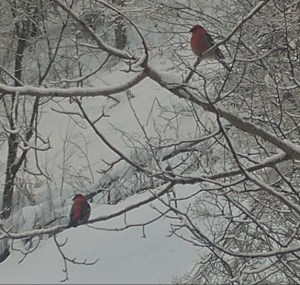 The birdfeeder is a circus of colour and movement: Steller’s jays, whiskey jacks, redpolls, nuthatches, chickadees, hairy and downy woodpeckers, a magpie and pine grosbeaks. On the fringes, a pine marten. A pair of ravens. Look, we say to our grandson, whose first language was raven squawks he made with his grandpa, raucous squawks the ravens answered. Look. There they are. Your old friends.
 Sheila Peters