Unknown's avatar

For Janet Elizabeth Dahr November 27, 1942 – January 9, 2012

I wrote this last fall after talking to Janet on the phone; it seemed as if, after years of adamant refusal, she was preparing herself to leave us. Because I had never been to her house, she sat in her kitchen looking out the window and told me what she saw, bringing me into that room with her.

I first got to know her online; she took a creative writing course I was teaching. Her sister and her daughter, Diana, took the course at the same time and I came to realize what a powerful trio of women I had in my virtual classroom. Later I got to know Janet in person as she came to Smithers to help Diana with infant twins. In spite of her own struggles with illness, her presence was wonderfully positive – and fun! She was, I believe, determined to make herself part of those boys’ lives in a way that would take root and grow as they did. What lucky kids!


Janet, my fingers are cold, the tips stained from making applesauce. There’s dirt under the nails. Yesterday an inch of snow, today the air is moist and warm as if someone piled a load of damp sheets into a nearby dryer and turned it on. I try not to feel the urgency this time of year brings with it and clean out the weeds around a few spinach plants, plucked low, some leaves still green and crinkled. I dig in some compost and old horse manure, flick away the fox scat left perched on the mint leaves poking in from the sidelines.

The garden’s dark and dirty heart is emerging from under the cover of carrots and beets and chard and cabbage. I leave the kale for the deer, wondering as I always do this time of year when there is so much food stuffed in the fridge, in the freezer, in the cool room, in the jars lined up underneath the bed, why on earth I planted it. Beyond the garden’s contours, the fireweed, nettle and cow parsnip lie down in their own dramatic death dance, the nettle still carrying a sting.

So I hoe back two shallow gullies and bend to plant Mr. Fothergill’s Emilia F1 spinach, each seed a couple of inches apart, feeling, as always as if this is the most ridiculous act of faith – even though every year the spinach and the carrots and the beets and the peas prove more worthy of my faith than any god I’ve heard tell of. The pea pods may not always swell, or the carrots fatten, but what they do give feeds my friends and family and doesn’t smite us with war and plagues and affliction. They just go about their sturdy business as best they can down here in the canyon where everything takes its time and for some things, that time is never.

The hoe covers the wrinkled promises and I tamp down the rows, covering them with mesh to keep the cat from digging there. In a couple of weeks, a layer of straw. And then I’ll forget about them as I always do. Three feet of snow hanging around until mid-April some years.

Then bingo. Garlic shoots and rumpled spinach green in all that dark dirt. Sandhill cranes, thousands of them, overhead. Harlequins riding the returning creek and juncos under the feeder.

Where in all of that returning light and sound will you be? Quiet in the sun still slanting in your window? Quiet in the memories of grandchildren too young to bear you consciously? Oh, you’ll be there, don’t worry. You’ve been planted deep, like those spinach seeds, already unfurling into a kind of green life that will nourish them, make them strong. You’ll be there.
Unknown's avatar

Visiting Bonnie Burnard

Joining a community of writers at places like Sage Hill, Banff, or any of the diverse retreats/residencies available to us these days, is usually a treat. We can begin conversations right in the middle of things because the writing process is familiar to us all, even though how we go about the work is as varied as human nature itself. We share the knowledge of what it is to sit down day after day to start moving our fingers and somehow transform whatever it is that goes on in our heads to words on the page, whether we’re using a pencil or a keyboard. If we wander around with a glazed look and don’t say good morning, other writers know enough to leave us alone. Best of all, you don’t have to explain what it is you do or why you do it.

Of course, egos and competitiveness are present, but at the retreats that are well run, there isn’t much grandstanding and the most acclaimed writers sit down with the novices and share stories as equals. It is very affirming for those of us who sometimes feel isolated from the writing world.

When I attended the Banff Writing Studio in 2002 and was told that I’d be working with Bonnie Burnard, I was more than a little anxious. The author of award winning short story collections and the Giller Prize winning A Good House, she was a very big name in Canadian writing, up there with Alice Munro and Carol Shields. She had just flown in from Mexico City with a nascent case of pneumonia; Banff’s air was cleaner, but the altitude did her in. I had one meeting with her before she was hospitalized, but as I’ve said before, that one meeting sent me on a long journey, taking Isabel from a short story I’d called “Frost Warning” and set in Smithers to Vancouver, Guatemala and deep into the lives of her daughter, Janna, and Janna’s father, Alvaro.

So when I arrived in London (Ontario) last week, I was tempted to track her down. I wanted to thank her and give her a copy of The Taste of Ashes. I was a bit nervous – her time in Banff hadn’t been easy for her (there’s a story there, but it’s hers to tell) and I didn’t think she’d even remember me. When I found out she lived very close to where I was staying, I finally screwed up my courage and called her. She seemed surprised, but very graciously invited me over the next morning for tea.

I’ve always been nonplussed by stories of people tracking down writers – searching for Pablo Neruda at Isla Negra, or nursing endless cups of coffee at the café Simone de Beauvoir frequented – so felt a bit nervous walking up the leaf-strewn path to her door right on the edge of the University of Western Ontario campus. And there she was, smaller than I remembered, welcoming me into her home and congratulating me on the publication of the novel.

Her house is a long one with glass doors opening into a sitting room, a sun porch, a living room, each room with multiple doorways. This kind of house is a treat for a child (and Bonnie has a new grandchild living nearby as well as two others) – the many nooks and crannies can provide escape from whatever might be happening in the house, but are also connected enough so he or she doesn’t feel alone. It’s the kind of house that exemplifies the kinds of plots I love to read and write – storylines that have their own lives but link in sometimes unexpected ways.

By which I mean to say we soon got down to talking about writing, about her writing life, about Banff, about how we go about things, how writers find ways to support each other, how we go through times when we lose sight of writing itself until we miss it so much, we sit down again and begin.

It was good to see Bonnie Burnard living in a comfortable house because so few writers make a decent living from their writing. It was a pleasure to sit at her kitchen table and talk writing because that talk is not always easy to come by.

While she expressed some concern about having suggested back in Banff that I write a novel, I said it was just what I needed because as soon as she said it a whole new world opened up for the characters living inside my imagination, characters her encouragement led me to release from the strict confines of what the current literary expectations are for short stories. Discursion is not permitted. (Even within the breadth of a novel, I have difficulty reining in my characters.)

So thank you, Bonnie. As for the writing talk itself, I look forward to someday reading in print the writing stories you told me.

Unknown's avatar

4000 Reasons

In June, I took part in an event in Smithers to celebrate all the people who stood up to speak to the Joint Review Panel expressing opposition to the proposed Enbridge Northern  Gateway pipeline project. The event, organized by the  Driftwood Foundation, included an afternoon of poetry and performance, a wild salmon barbecue, and an evening concert featuring many regional performers, including Wet’suwet’en dancers, Rachelle Van Zan Zanten, Alex Cuba, Magpie Ulysses, Miriam Colvin, and Los Gringos Salvajes. To view this video, go to https://vimeo.com/51033807.

Unknown's avatar

Hit the iron bell like it’s dinnertime

I’ve just finished reading tiny beautiful things: Advice on love and life from Dear Sugar by Cheryl Strayed. I first came across Dear Sugar in The Sun magazine – a wonderful magazine of fiction, non-fiction and poetry. Its contributors speak in a voice similar to Sugar’s. Fearsome advice, often, and harrowing stories that are above all else, beautifully written.  Cheryl Strayed is a very big deal now (she just “came out” as Sugar and also had her new novel, Wild, kick-start Oprah to begin a new book club. It’s always a bit tough when a tiny beautiful thing you’ve come across unexpectedly turns out to be a very big thing many people know about and have been following for years. But what the hell – she’s great.

And while the book covers all the usual topics – love, work, children, addiction, Christmas and stupidity – it is also a handbook for writers. Her tone is reminiscent of Anne Lemott’s Bird by Bird: Some Instructions on Writing and Life. Like Lemott she has a history of addiction, abuse and general trauma that she refers to when she responds to those who ask for advice. Her language is blunt and sometimes brutal. But she tempers it all with generosity and kindness.  We all fuck up, she says, and that’s how we learn. She answers a letter from a man who has lost his son in a car accident and is actually useful. She tells you to get on with it while acknowledging that nothing will remove the pain you’ve experienced. The bad things that have been done to you. The awful things you have done. Above all she tells you to face up to your bullshit  (and others) truthfully and keep climbing out of whatever hole you’re in.

“We’re all going to die, Johnny,” she writes. “Hit the iron bell like it’s dinner time.”

Which is all great advice for a writer. Get on with it. Write. Write truly and write well. “Write,” she says, “like a motherfucker.”

Unknown's avatar

Love Electric

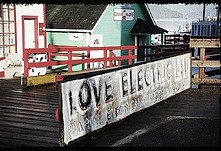
It all began with the sign down at Cow Bay in Prince Rupert. It hung on the weathered boards outside an automarine store right down there beside the docks, the name spelled out in fading black paint: Love Electric.

ImageThe building dates back to 1919 and still stands. But it no longer houses Love Electric. (I just checked to see that the company is still operating – it is. Its email address is lovelectric@hotmail.com. Come Valentine’s Day, it might be fun to send them a message.)

I was sitting in a coffee shop just down the road and started scribbling. I wrote three stories about people who had unexpected sex with unlikely partners: a suicidal meter reader, a bored housewife who decides to become an electrician, and a woman working in a Saan store. Isabel. I took Isabel along with me to the Banff Writing Studio, where I worked with Bonnie Burnard (A Good House, Suddenly). She suggested I turn it into a novel. At first I quailed at the thought, but ideas just came pouring out and I was off on a journey that took me to some amazing places – both physically and emotionally: the back rooms of a Saan store, the cemetery in Guatemala, the provincial house of the Oblates, the streets of Vancouver’s downtown eastside.

I wanted to explore the life of a woman others might think of as a victim or an irresponsible parent, but who views herself as someone strong, who makes mistakes, yes, but keeps going and refuses to be judged. You could maybe call this “family practice.” While mothers mostly love their children, sometimes their children are not particularly likeable. And visa versa. Isabel and her daughter Janna need to make their own way in the world, but also reconcile. Figuring out how to make this happen was much of the fun of writing this book. And it made me realize that sometimes it is the most dysfunctional families that are best equipped to dig in during crises and really support each other.

One of the difficulties for both of them is Isabel’s refusal to tell Janna who her father is. You know how it is when you keep a secret too long? It gets harder and harder to come clean. Which brings in the issue of the Catholic church (now there’s an outfit that knows all about secrets) and the behaviour of its priests. Father Àlvaro Ruiz snuck up on me as I was writing The Taste of Ashes. I am not Catholic and am more than uncomfortable with many of the church’s teachings. But I am fascinated with the way people of amazing diversity negotiate their way through that to make themselves a place within the church. They stick out their elbows and wriggle their way in. Often their very presence makes people uncomfortable because it forces them to re-examine their own beliefs. As Àlvaro struggles with this, he finds links with his Mayan heritage and that of our own First Nations communities – links that Catholic missionaries may think they forged, but are really connections that have roots in a much older indigenous spirituality linked to the land itself.

What has been intriguing for me in this process is the way I’ve come to feel about the characters in The Taste of Ashes – not just the three main characters but some of the secondary ones as well: Margaret Coleman, Amy Myerson and Father Walter. They are like old friends now, people who have shared many experiences with me. In the novel, we’ve all come to know each other. Publication has given me a chance to introduce them to you.

Unknown's avatar

Nuchatlitz

We recently stayed in a cabin on a small unnamed island near Nuchatlitz, a former Nuchatlaht community off the west coast of Vancouver Island. The small island is privately owned by twelve people, but most of the surrounding area is either reserve or provincial park. We were there to kayak, but we were also visiting a place we’d read about. In 2001, our publishing company, Creekstone Press, reprinted John Gibson’s A Small and Charming World, a book first published in 1972 that told of Gibson’s time as a social worker in Smithers and later in Campbell River. The book’s last chapter contains a particularly poignant reference to Nuchatlitz.  At one time about 3000 people lived in the area, but when he flew in to pick up a little girl going to school in Campbell River, only five houses were occupied. When we were there, one unoccupied house remained and its last occupant, Lily Michael, was buried in the overgrown cemetery across the inlet. We so often think of these isolated places as wilderness, but they have been occupied for centuries, and contain many stories. Which is why writers look for places like this.

Virginia Woolf told us we needed a room of our own. In the Sea Watch cabin in Nuchatlitz, also known as Witt’s End, there are many rooms, each lined with books. Among those books, I found a collection of essays by E.B. White, The Second Tree from the Corner, in which he contrasts his writing practice to that of a contemporary who sits down at home where his “privacy is guarded” and works in an orderly and diligent manner to accomplish a great deal. White says that his “professional life has been a long, shameless exercise in avoidance.” His home is, he says, “designed for the maximum of interruption,” his office the place he never is. How can a writer not love E.B. White? How can a writer not love Witt’s End?

While each room has a table inviting the writer to sit down with a notebook, out the windows are sea otters, cedars, rhododendrons, driftwood installations, and a greedy young crow eating the salal berries growing out of one of those installations. And the books. Downstairs, Chinese literature, the classics, fiction, history, the restoration plays. Bill Kinsella, Margaret  Atwood, Virgil, A Dream of Red Mansions.

In the kitchen, beside the binoculars on the windowsill, the plant/bird/seashore/animal guidebooks.

You must climb the steep stairs to find the poets, ranged along the floor in a room with windows on three sides and skylights, a bed tucked into a dormer, the chimney from the wood stove below bringing warmth into its spaciousness. And a table, of course.

I brought a collection of Bruce Chatwin’s work along and, while it started well enough, seemed to become one of those publications designed to plump the coffers of his estate – some work would have been better left “unpublished or neglected.” In it he writes about the two towers where he writes well – one on the Welsh border and one in Tuscany. It is, he says, “a place where I have always worked clearheadedly and well, in winter and summer, by day or night – and the places you work well in are the places you love the most.”

Seawatch could become one of those places – and writer Paula Wild uses it for her own escapes and also runs writing retreats there. Shannon Bailey, the co-owner with Brian Witt, writes there too. She and Brian left Victoria (where she completed a Creative Writing degree at UVic) over a decade ago to live almost full time at Nuchatlitz. You really are a long way away from anywhere – an hour’s boat ride from Tahsis, which is about a three-hour drive from Campbell River.

You’d think it would be perfect. But the work to keep a place like Sea Watch running (solar energy, rain water cisterns, generators, boat maintenance and wild west coast weather) is, as White said, “designed for the maximum of interruption.” Like waiting for the right tides to put the sailboat up onto a neighbour’s makeshift dry-dock in order to scrape the barnacles off the hull, messy and physically demanding work, done in the dark, in the pouring rain. And anyone who’s lived in a place with only boat access knows the minutiae of hauling things up and down docks, in and out of boats, and offloading at a slippery low tide.

And then there are the distractions of all the artifacts the ocean offers up.  There are hundreds of installations in every available space, inside and out. Shells, skulls, feathers, tiny congregations in mossy corners, as well as the reminders of the many places Shannon and Brian have travelled.

The perfect retreat, I think, needs to be someone else’s tower – as Chatwin said. Where someone else is bringing in the groceries, doing the upkeep, weeding the gardens. Or, as I suggested to Shannon – a real winter. I always look forward to October here in Driftwood Canyon – dropping temperatures put a quick end to any silly notions about another crop of spinach, by November the snow covers all those projects that call for attention all spring and summer, and it’s dark so early and so late, you’re not distracted by the play of light on the trees. You leave the curtains open and stare out into the darkness, thinking.

This slideshow requires JavaScript.


Thanks to  Dan Shervill for letting me use some of his photos.

Unknown's avatar

Don’t try this at home

I found a collection of E.B. White’ essays – The Second Tree from the Corner – while staying in the Seawatch cabin last month (more on that later). The title essay is especially beautiful and there’s a great piece about thieves stealing a car’s tires while leaving valuable jewelry untouched. “Roses are red,” the thieves write, “violets are blue – we like your jewels but your tires are new.” Not a poetic thief, White argues, but a case “of a poet who was willing to attempt any desperate thing, even larceny, in order to place his poem.” How long the poet much have searched, White writes, to find just the right spot for this particular verse: “Poets endure much for the sake of their art.”

Unknown's avatar

Greenhouse pleasures

We live in a canyon with significant gardening challenges – about a Zone 2 if you are interested in such things. We have figured out what grows well here and pretty much stick with that (I am always making writerly analogies when the work isn’t growing well, but the place really suits me just fine).

Right now the wind is tossing the willows outside my window, some already turning colour. But just a few miles away, writer Jane Stevenson (The Railroader’s Wife) grows amazing things in her huge greenhouse. A writers’ group exercise resulted in this ode  (with a nod to Kate & Anna Mcgarrigle’s Southern Boys).

Ode to a Telkwa watermelon

At first
such a surprise
that these pale yellow flowers
wan and thin-petalled
amidst their intricate leaves
could become this green-striped globe
fat on the greenhouse ground.

But then
you notice
the unobtrusive tip of the vine
threading it way across the ground
to the scarlet runners
and you remember…

…oh, those southern boys!
so wily
so plump
so firm.

Unknown's avatar

Getting it out there

On the road with The Taste of Ashes, I gave readings in Campbell River and Powell  River. I always enjoy these conversations with book lovers – thanks to those who attended.

I also had an interview with Sheryl Mackay of CBC’s North by Northwest weekend arts and culture radio show – she’ll be airing the interview Saturday, Sept. 8 just after the 8:30 news.