Unknown's avatar

A Five Dipper Day

dipper-1-600x400

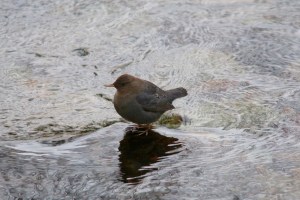
I might as well name the American dipper (Cinclus americana) my spirit animal. I frequent streams, especially the “clear, rushing, boulder-strewn mountain streams, within tall conifer forests. [I]float buoyantly and swim on the surface (poorly) by paddling with unwebbed toes. [I] frequently walk about on the gravelly bottom of streams.”

Chunky, fairly nondescript, not very musical except for moments in the spring when it even surprises itself.

The dipper is our only aquatic songbird. It feeds on the little creatures that live in the water – caddis flies, mayflies, mosquitoes (whoopee!) and also dragonflies, worms, fish eggs and even small fish. In winter, it’s hard to believe there’s anything in that water, but if you can find  a pebble to flip, you’ll see little shrimp-like wigglers squirming for cover.

I’ve only seen two nests – one in winter when we snowshoed down the creek all the way to the Bulkley; the other, the parents actively attending to the chicks inside, was behind a noisy waterfall in the Rockies. The nests are always near, and usually overhanging, a mountain stream, but they are easy to miss because they look like a clump of moss. Under bridges is another good spot to look.

Males and females may work together to build the ball-like nest, often in freezing temperatures. Materials are dipped into water before being woven into two layers: one, an outer shell, 8-10 inches in diameter, made of moss, and the other an inner chamber with a woven cup, 2-3 inches in diameter, made of grass, leaves, and bark. Once the nest is finished, the mossy shell absorbs moisture and the coarse grass keeps the inside dry.

Every birding book and website says they are mainly solitary, that after a pair brings its chicks to fledge, the parents usually divide the brood and head off to separate territories. But this fall and winter, we’ve seen two and very occasionally three foraging within a few feet of each other. We find one almost every day.
dipper-2-600x468

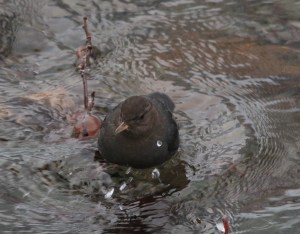
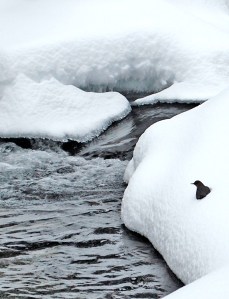
Sunday was special. A grey and gloomy morning, the road an inch-thick crust of ice. At the first dipper viewpoint, I spotted one in a newly opened pool just above a big log jam. We watched each other for a while and then I looked up the creek to where our snowshoe track had collapsed into another pool. Another dipper. And then, further up again, a third one.

Another km up the road, at an opening where we always look but rarely see them, there was another. And on the way home, looking downstream from the bridge that crosses the creek just below a tiny stream flowing out of a trickle of little springs, springs that never freeze, a fifth.

The dipper. Industrious. Likes the outdoors. Tends to stay resident all year round. Enjoys poking around under rocks in creekbeds. Spirit bird indeed. Almost forty years of turning over stones, tossing them in and skipping them across Driftwood Creek. Listening for the bird’s sharp alarm call.

Last fall, my grandson and I were both hunkered down beside the creek lynn-and-casey-at-creek-2-399x600when I started telling him about dippers. Just as I had told his father and uncle more than thirty years earlier. How they dive under the water and walk around on the bottom, how they blend right in with the stones they stand on, how they squawk as they fly up the curve of the creek.
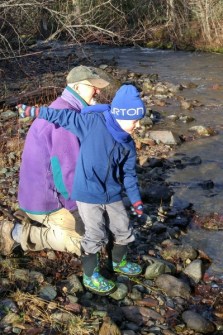
One popped out of a nearby pool and looked us over, tilting its head, one eye zeroing in. The white eyelid. It hopped closer and closer. I held onto my grandson’s arm, stopping the pebble he was about to throw. We all watched each other for several seconds, me doing the little bobbing dance we always do when we see one: dip, dip, dip, dip, dipper!

The boy’s shout of laughter made that moment even better than a five dipper day.

(Thanks to Uncle Dan for the dipper photographs)

After reading this post, Mark Tworow sent this lovely reminder of summer and the creek in a completely different form.

Hi Sheila

I’ve attached Driftwood Creek in the Summer, one of the largest paintings I’ve ever done. (48 x 72)

driftwood-creek-in-the-summer-800x533

If you walk from the summer parking lot towards Sunny Point there’s a a small climb down a rocky slope to this pristine view of Driftwood Creek. The painting at such a large scale hoped to capture a small part of the feeling one has of this beautiful crystal clear creek tumbling around the water smoothed boulders. How many years has the creek flowed through here? The smooth boulders give a small answer, though the course of the creek has probably changed through the years. If you pass this place one summer, stop and pause here. It is a full place.

I think you might likely spot a dipper here too.

Mark

Sheila,

You can tell Mark that dippers live, fly and dive all along the Driftwood cinclezenrock_francoidepeycorridor…and yes indeed right downstream from the location of his painting by a place some locals refer to as Zen Rock.  I was lucky enough to catch one of them with my camera a couple of winters ago.
Cheers,

Françoi (Del Pais)

Unknown's avatar

The Mystery of Water

A soft mist of rain falling on even softer snow. The road a sheet of ice.  A pair of resident ravens squawk from the spruce trees down in the gully.

The January thaw, Joe L’Orsa patiently explained during my first winter here.

Great plops of snow slip off the roof, off the drooping alders. You can hear the crystals shifting.

Right now the creek is mostly silence. Snowshoeing just a couple of days ago, before this thaw, its voice is hard to track. At times the path is as quiet as any terrestrial winter trail when the snow is powder. At times the creek gurgles on our left from under that big old spruce curving way out beyond the bank. Then on our right, where the creek turns against its own current. At times a pool opens and we watch water moving over a sudden clarity of stones. Even when we’re breathing air that measures minus twenty. No wonder the dipper dives in.

dipper-on-ice-2-600x400

Dan Shervill photo

The mystery of water. How can it run at all when it’s been well below freezing for several weeks now? How can this side hill ooze moisture even after the frost has burrowed in deep? And why has our snowshoe path from a couple of days earlier disappeared into a new opening?

You think it’s going to happen again when the solid thunk thunk thunk of your snowshoes and the trail’s responding crunch shift into the hollow sound echoing from an air pocket under the ice. You hold your breath and hope the ice holds. You wonder, how big is the air pocket? If the ice suddenly opens, you hope the drop won’t be too far. But you know it’s there. And no matter how hard you try, you’re never ready for it.

The January thaw. The strangeness of rain falling on the snow still covering the ice under which the creek flows. The mystery of water.

Unknown's avatar

Forty Years: A Celebration of Driftwood Creek

creek-freezing-400x225

January 1977 – I moved to Smithers to work as a reporter at The Interior News, a paper with a venerable history and a crack reporter on staff. I was a new graduate and needed a mentor. A month later, he quit and I was the senior reporter. Now that was fun. Five months later I moved into a ratty little cabin the crack reporter (now working at the local bookstore) had purchased. A year later, I married him. And we’re still here, deep in the heart of Driftwood Canyon.

Our home is in Laksilyu territory of the Wet’suwet’en people in the House of Tsee K’al K’e yex (House on the Top of Flat Rock); the chief is Wah tah K’eght (Henry Alfred). Across the creek is Woos’s territory.

creek-2-225x400


This morning we strapped on our snowshoes and travelled a few kms down the creek. Minus 16 and the sun was shining up high on the canyon rim. The alders have grown about as big as they get around here – thirty years since the big Father’s Day flood scoured the creek clear of the small stuff and a few huge cottonwoods besides. But a route that we’ve skied and snowshoed many times is wide open. The log jams we used to clamber over are gone, the tricky rapids solidly frozen. It hasn’t been this cold for this long for years. It’s wonderful.


When I started thinking about a new writing project a few weeks back, stalled as I am on a series of poems, on a stubborn short story, on an unpublished novel, I was in the middle of reading Dart by Alice Oswald. A book-length poem Oswald compiled/created over three years, it traces the Dart River from its origins in Dartmoor in southwest England about twenty miles to its estuary at Totness and on for another nine miles to the English Channel at, of course, Dartmouth. She collected stories and narrates the poem in the voices of those who have lived, worked and played along its length.

Near the beginning, she speaks in the voice of an upland hiker:

What I love is one foot in front of another. South-south-west and down the contours. I go slipping between Black Ridge and White Horse Hill into a bowl of the moor where echoes can’t get out

listen,
a
lark
spinning
around
one
note
splitting
and
mending
it

and I find you in the reeds, a trickle coming out of a bank, a foal of a river

one step-width water
of linked stones
trills in the stones

What’s not to love about that?

We’ve all spent a fair bit of time thinking about the Sacred Headwaters over the past years. The Skeena, the Nass and the Stikine all rising out of a series of wide wet meadows high up in Spatsizi country. Many of us watched on film as Ali Howard searched for the Skeena’s beginning to start her epic swim to tidewater. Coalbed methane at the top end, fish farms proposed for the bottom end and the damn Northern Gateway project proposed to run right across the watershed’s eastern reaches. All done, all sorted. (I’m not going to start about Lelu Island here – the proverbial elephant in the room.)

snowshoe-hare-400x225Instead, I’m going to hunker down beside Driftwood Creek as I have so many times over the forty years I’ve lived here. In the early days, I read Annie Dillard’s Pilgrim at Tinker Creek. I loved the intensity with which she examined that creek flowing out of Virginia’s Blue Ridge Mountains. But I’ve got to tell you, the aquatic life is a little harder to find in a mountain stream that drops from an altitude of about 5000 feet in the Babine Mountains to its confluence with the Bulkley River at about 1200 feet in under thirty km. It never gets much warmer than ten degrees and I speak from experience.

small-creek-225x400Thank god for the dipper, which I thought was a tall tale when a couple of friends told me about it for the first time. A little grey bird that dives into the water and walks around looking for food, even when it’s forty below and there are only one or two openings in the whole damn creek. No way, I said. The water ouzel. I saw one a couple of days ago singing like it was spring.


So many stories. It’s too late to say, “Don’t get me started.” Instead, I’ll raise a glass of creekwater to celebrate its stubborn beauty.

PS. I’d be glad to hear your stories too – I’ll happily post them here.