Unknown's avatar

Disposition of the Dead*

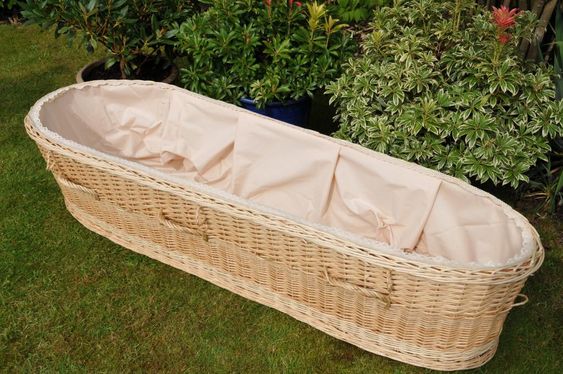
I first came to this topic because Lynn and I were trying to decide what to do. We’d always thought we’d be cremated, but green burials seemed like a good idea and if I’m honest, it was the lovely basket coffin with its cotton bedding we saw on a hospice tour of Stubberfields Funeral Home that really attracted me. So tasteful. So comfortable.
And the Cranberry cemetery is beautiful. A little sedate – not much room for flair – but peaceful and sunny. If we were cremated, we could also go to the Kelly Creek cemetery. It is lovely and crazy. But do our kids want to do something zany to remember us by? It’s not really their style. We’ll have to take them there and see what they think.
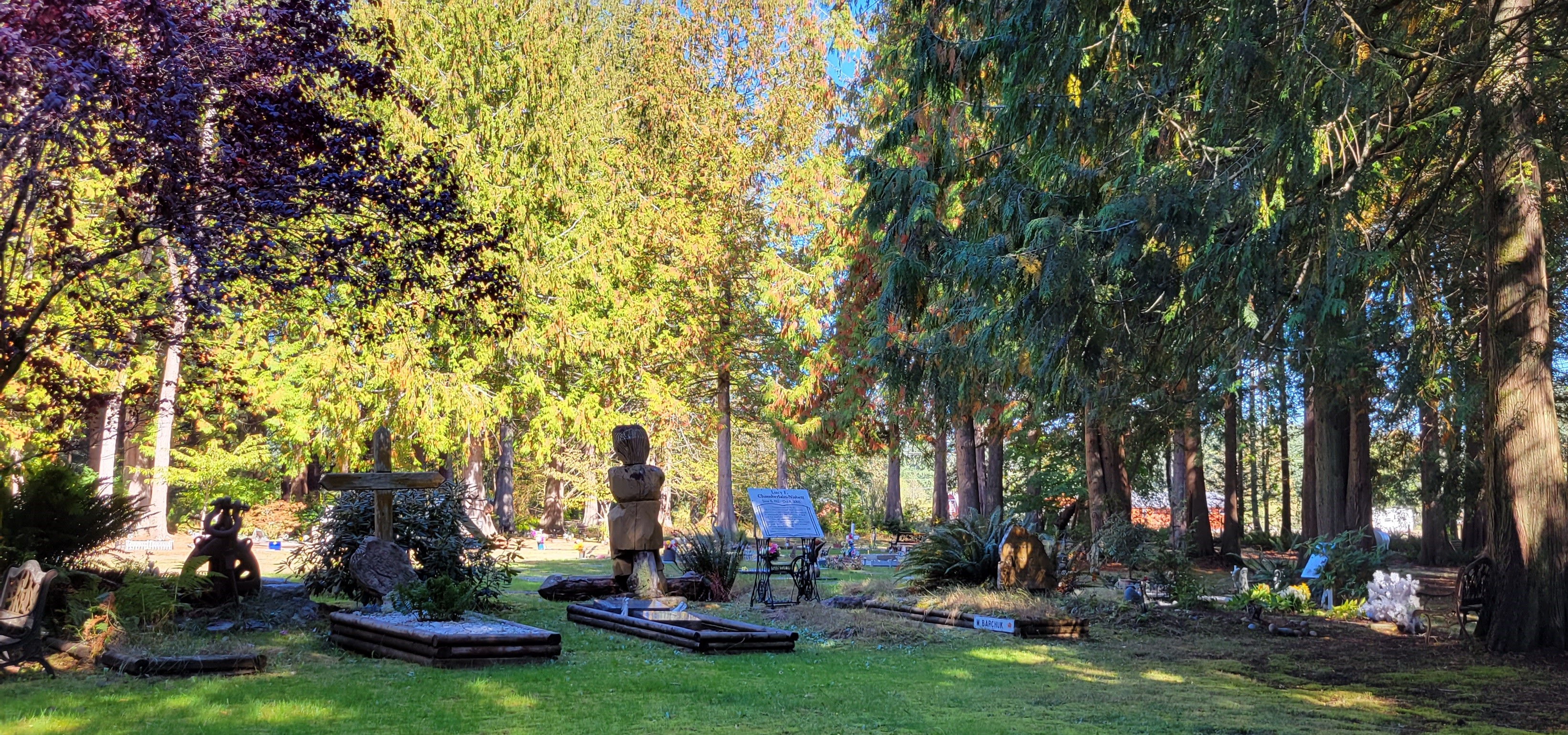
The Holy Cross Cemetery on Nassichuk Road in Kelly Creek

While researching this, my mother, who was 99 and in good health, suddenly declined and we were, while mourning her death, busy putting into action her wishes about cremation, burial, and funeral. It brought back lots of memories, or their lack.

When my dad died in 1970, it was very sudden – post-polio syndrome. He was right upstairs when my mom came down to tell us, but I didn’t go to see him. I don’t know why. My brother remembers going. I was in a very strange place. Friends came by and what I mostly remember is I wasn’t wearing my usual mascara and eyeliner. Of course, no one noticed, but I stopped wearing it after that. It seemed pointless. Went back to school within a day or two.

Dad wasn’t cremated until his parents were able to get here from Saskatchewan. They wanted to see him. I think they asked me if I wanted to go with them to the funeral home, but I didn’t. Was he in the church for the funeral? I don’t remember. As I said, I was in a strange sixteen-year-old frame of mind.

I must have had some notion that cremation meant the body disappeared – that there was nothing left. There was no talk of ashes, of burying them or of spreading them. I didn’t think much about it until years later. I asked Mom. She’d left them at the funeral home. He was gone, she said. The ashes held no significance for her. After that Stubberfields tour, I asked the director Patrick Gisle what he did with ashes left behind. I actually wondered if they could still be there, fifty years later. He told me it happens regularly and he has a few quiet places he spreads them.

I suspect Dad’s parents would have liked to bury them in the lovely little prairie cemetery where they’re now buried. There’s something beautiful about the expanse of land and that big prairie sky. Dad might have liked it too. He was at heart, I think, a prairie man. My friend Margaret’s family has a private graveyard in Manitoba, near what’s left of the family farm. On her regular trips to the small town where her brother David lived until his death a couple of years ago, she tends to the graves, which go back at least four generations.  She has a deep sense of attachment to the place and its history. She’s thinking she’ll have her ashes buried there.

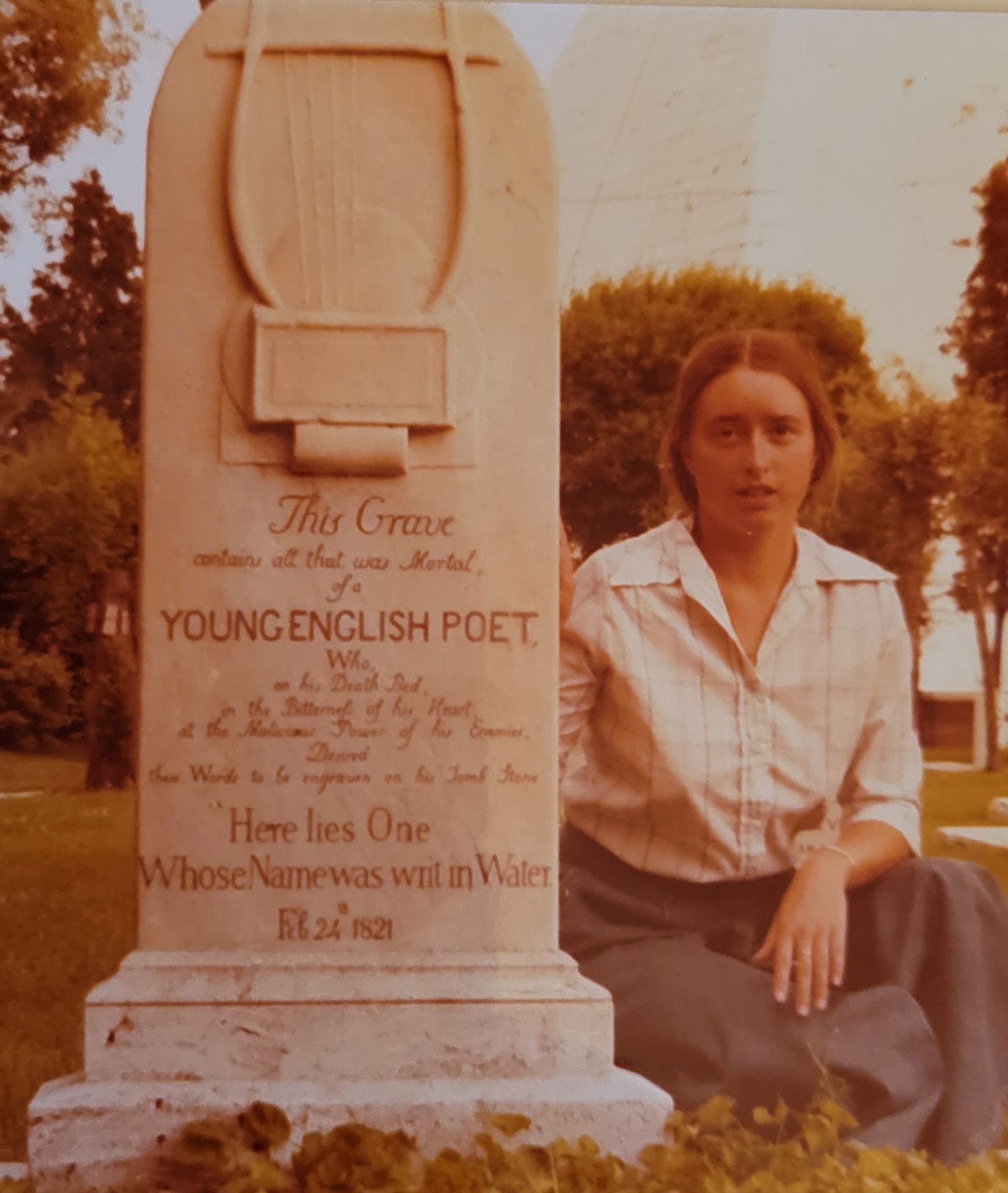
Cemeteries give a kind of permanence to the disposition. They form part of the historical record and can become places of both private and more public pilgrimages.  I remember visiting, in 1977, the grave of the poet John Keats in the Protestant cemetery in Rome just after going to the rooms beside the Spanish Steps where he died of TB in 1821. He was 25, a year older than I was then. I’d been reading his letters. His friend, painter Joseph Severn, described his death: In the afternoon he uttered his last words ‘Severn-I–lift me up–I am dying–I shall die easy–don’t be frightened–be firm, and thank God it has come!’ That night he expired, ‘so quiet’ that Severn still thought he slept. I found myself in tears – so moved by his youth and his generous heart. His epitaph broke my heart: Here lies one whose name is writ in water.
Although tombs can become the focal points of terrible conflict, visiting the graves of celebrated figures connects us to our cultural and religious communities, whether it’s Jim Morrison in Paris or the Taj Mahal in Agra. On a local level, participating in the cremation, the interment of the body or the spreading of ashes connects us on a more intimate level to our family and friends.

The past fifty years, at least in North America and Europe, have seen the creation of rituals to replace the Christian traditions many of us have left behind. Children decorate their grandparents’ coffins, ashes are turned into jewelry or sculpture, spread from helicopters (or in the case of Hunter S. Thompson, shot out of a cannon). Notes are tucked into urns, shrouds are woven by the intended user and proudly displayed, coffins are built in distinctive shapes; a popular example can be used as a bookcase until it’s needed for burial.

To reduce both financial and environmental expenses, Community Supported Dying qathet lends out a handmade and decorated coffin to transport an enshrouded body to its burial site at the Cranberry Cemetery.
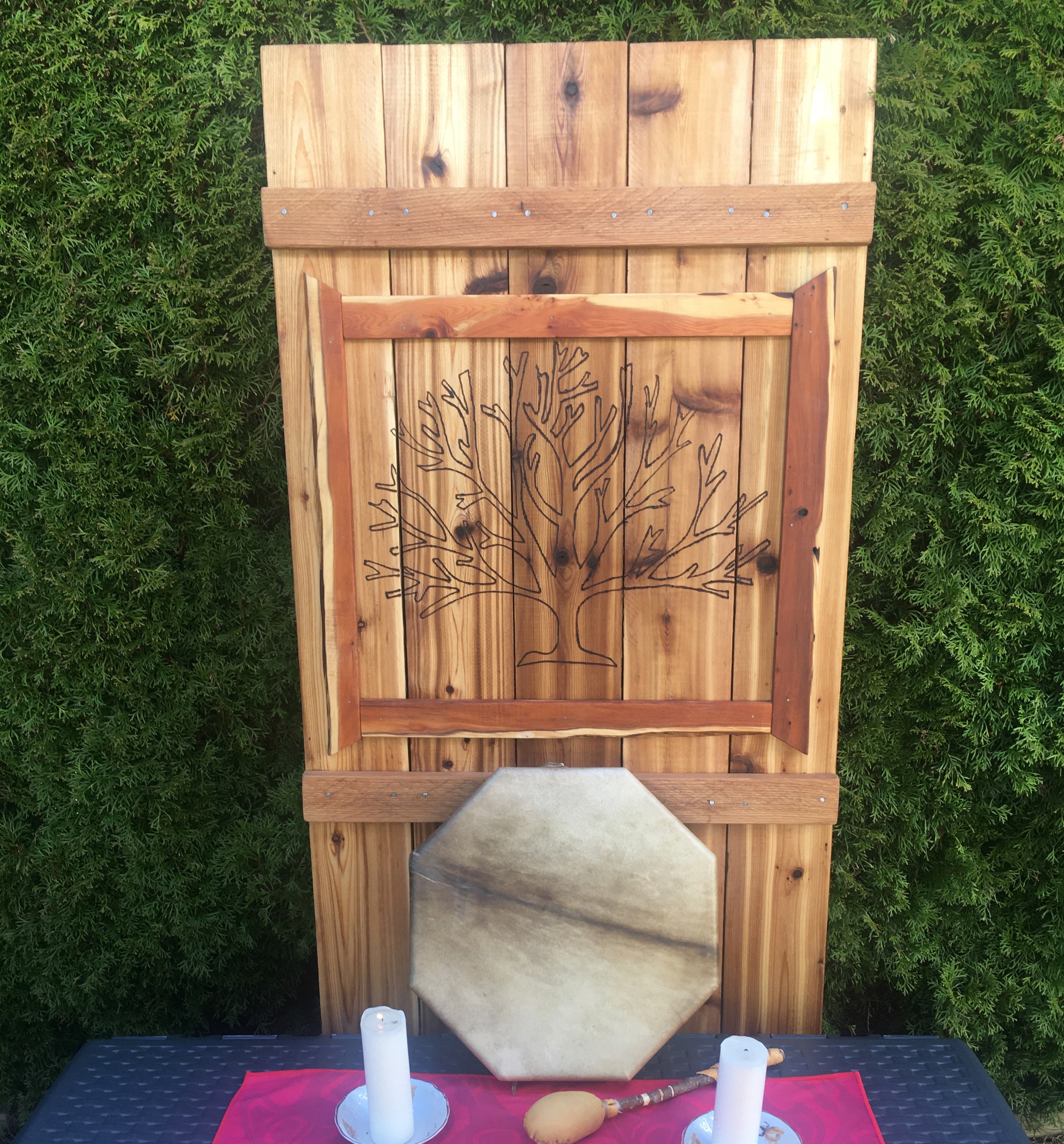
Borrowing a Tibetan tradition, we started hanging prayer flags after a trip to Nepal, liking the idea of the wind carrying prayers out into the world, helping us all in the work of practicing compassion, of relieving suffering. The spot we chose on our property near Smithers funneled the wind blowing through from one mountain range down the canyon of the creek we lived beside into the watershed of the Wedzin Kwa and on to the great Skeena passage. I sewed together my mother-in-law’s beautiful hankies in her memory; we made flags out of old linen napkins with poems and blessings written on them. We spread ashes among the willows and aspens facing into the sunniest opening in the canyon walls. We created our own sacred place.

But then we moved. It’s on someone else’s property now.

We hung prayer flags from the lighthouse beside our house at Grief Point, or χakʷum by its ʔayʔaǰuθəm name, but it doesn’t have the same sense of private pilgrimage. The land was alienated in the 1890s and our subdivision was built in the 1960s. Tla’amin artifacts were found during the extensive excavation work, underscoring the ways in which precious places can be overrun, lost.

Cemeteries are perhaps an attempt to keep that sense at bay. My grandma, aunt and soon my mom’s ashes will be buried in Cranberry. My sister has reserved a plot there too. I suspect in one form or another Lynn and I will end up there. Still not sure what form that might take.

Mom and I visited the Cranberry Cemetery just a month before she died.
  • This piece came out of research done for an article by the same name published in qathet Living for its Memento Mori issue in November 2023 and a gathering I led for one of the qathet Art Centre‘s Memento Mori events November 15, 2023.
Unknown's avatar

Knitting socks

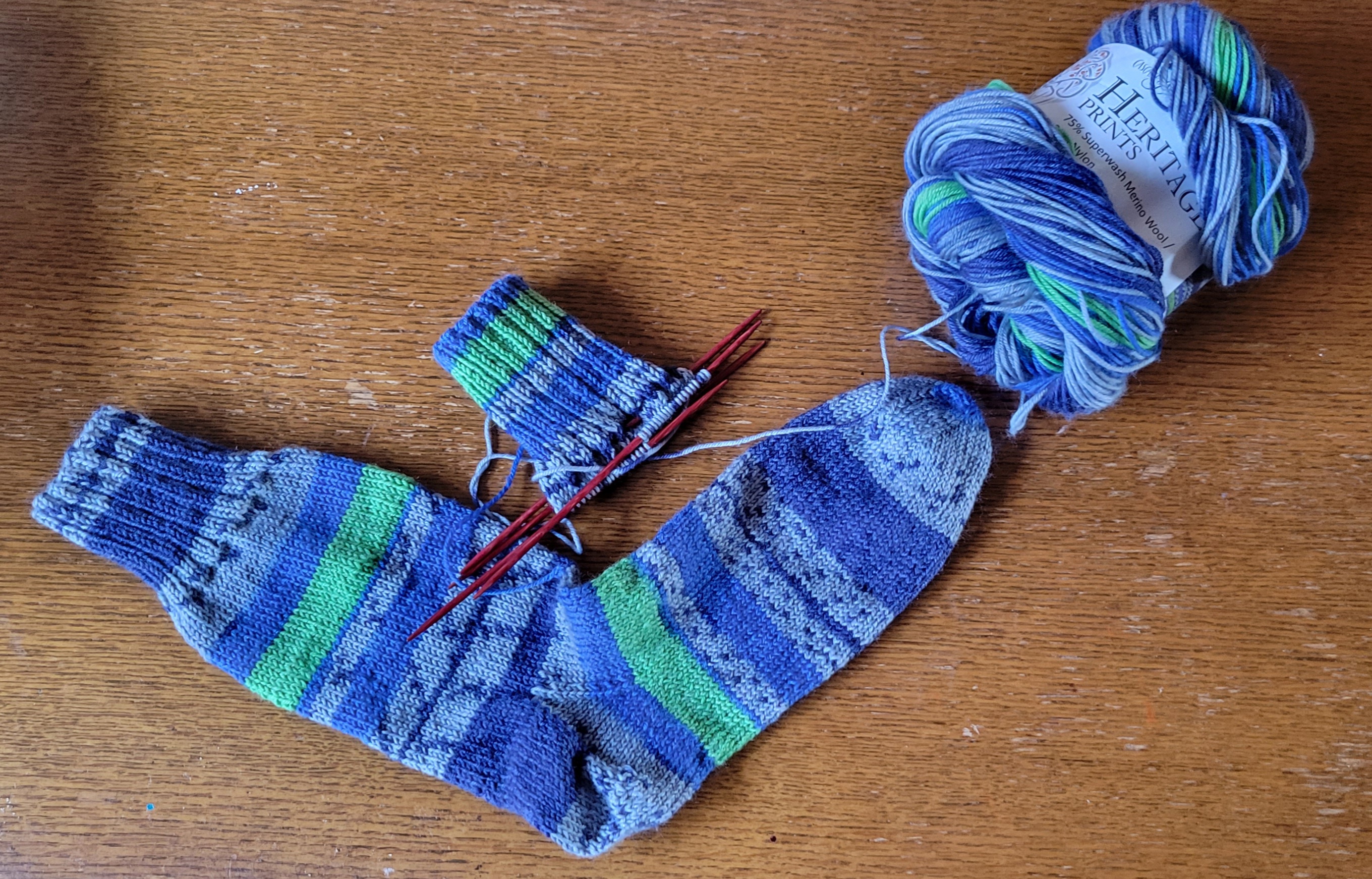
I was in the kitchen I think, when Mom walked in with her old knitting bag. She pulled out a ball of variegated sock yarn and behind that, three needles carrying a tangle of stitches. The fourth needle dangled from their midst. It was heartbreaking. After she couldn’t read anymore, she could still knit. And she did. Socks for her grandsons. But now she couldn’t, not even the socks she’d been knitting for decades. Stitches dropped, yarn carried across the gaps, needles turned so the most important part of a sock, the hole into which you place your foot, was gone. I almost cried. There was so little left.

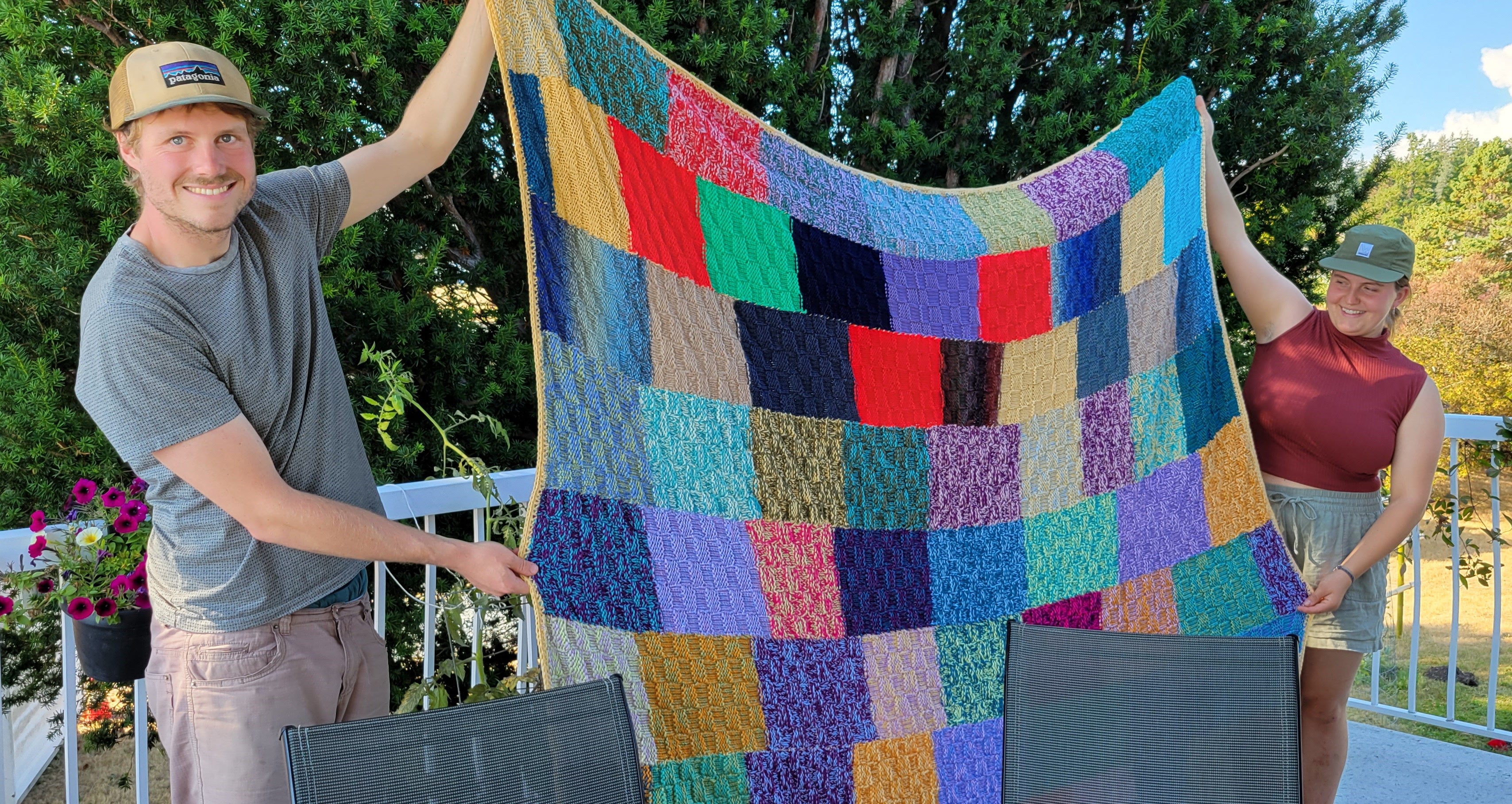
Just a few months earlier, she was still able to knit if I was nearby. She knew when something went wrong. She knew, but couldn’t see what it was or figure out what to do. I’d take it from her, fix it up and hand it back. Watch for a moment to see she was back on track. Together, we’d also been able to finish a huge blanket she made for one of her grandsons, Chris. She gave it to him just a couple of months before she died. We had so much knitting fun over the years, visiting wool shops, sitting together knitting, talking about patterns.

I just read an Ann Patchett essay, How Knitting Saved My Life. Twice, in which she describes how she’d come back to knitting when travelling in Ireland. When she made a mistake, she’d hand her knitting to any woman who happened to be nearby and ask for help. They could always fix it, she said, and if they had time they’d teach her how to fix it. I remember Lynn, when he was learning and I wasn’t nearby, going into yarn shops and asking for help. Always freely given.

It wasn’t until I was going through Mom’s belongings after she died in September that I came across her sock pattern. She never referred to unless it was time to turn the heel. Over the years, how many times did I hear that phrase, just wait until I’ve turned the heel? It required concentration and careful counting. My heart broke all over again to see the raggedness of the paper onto which the pattern had been glued how many years ago? The pattern calls for P.K. Victory Fingering Yarn and must have dated back to the 1940s, when girls knit socks for soldiers. It refers to Maitland Spinning Mills, Ltd. Listowel, Ontario. A division of Mercury Milled Limited. Hamilton, Canada. She’d likely have knit a few socks back then, for she knew men who were overseas fighting. One, Leslie McLean, whose letters I found in a box tucked away in a drawer in her bedside table, was killed in action in 1944.

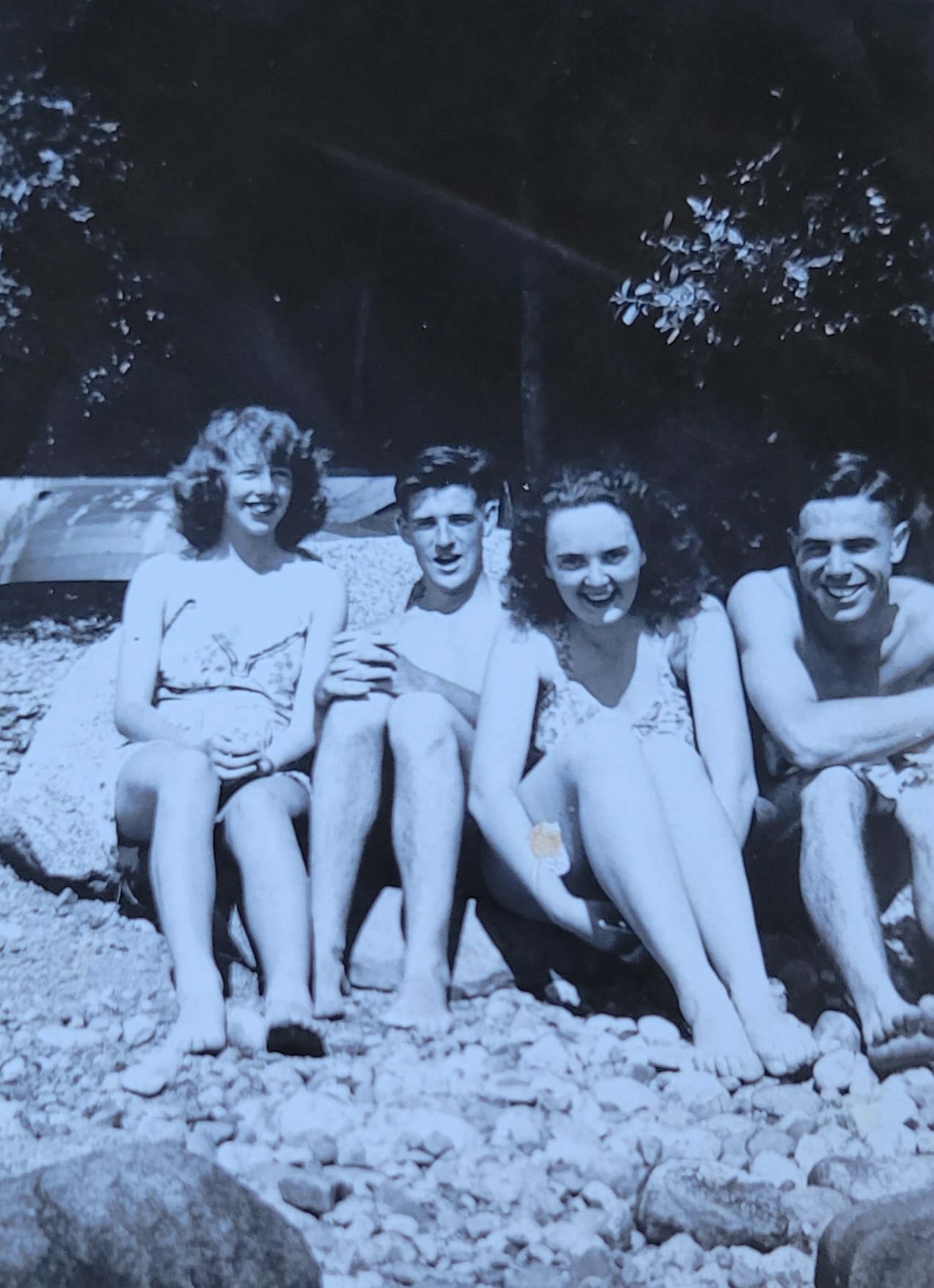
Mom, Leslie McLean, Hilda Nuttall, and Frank Dickson, 1942

I don’t recall her knitting much when I was a kid. My grandma did, and she could make the needles clack, she was so fast. The socks just whizzed off her needles. I tried using her old steel needles and the knitting belt an admirer made for her, but was never fast enough to make them sing.

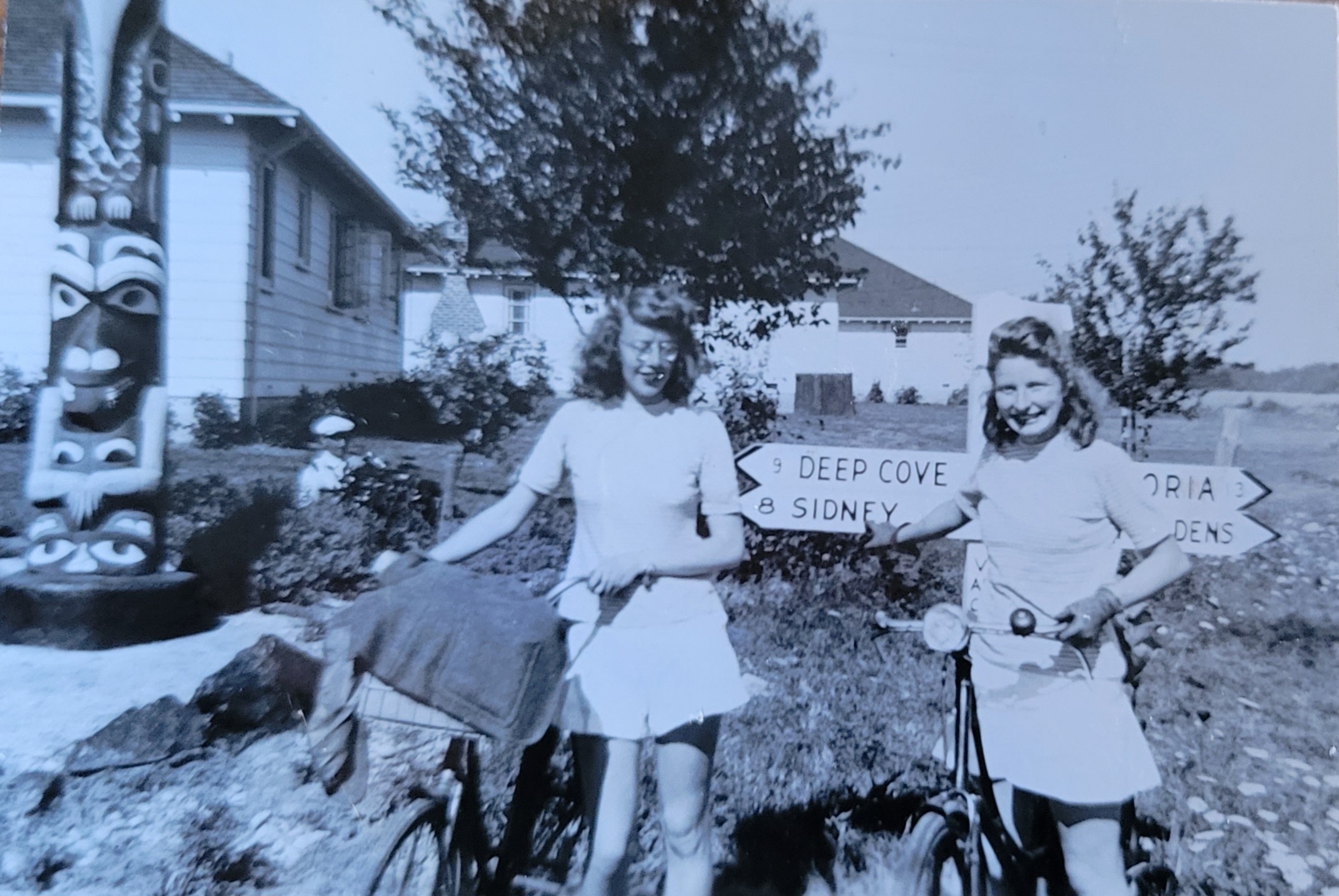
When Mom lived on Vancouver Island in the late 1940s, she and her best friend Flo rode their bikes from Victoria to Powell River. Did they ride them back too? Did they take a Union Steamship across? I never did get the story straight. But for the next 70 years they visited back and forth and exchanged patterns and wool and went out for a Dairy Queen Blizzard whenever they were together.

But just as she lost her sight, she’d lost many of those memories unless you found the right questions to ask. Always tricky, that. Finding the right questions. And now we’ve lost her too.

It’s hard remembering her walking into the kitchen that morning, wanting to knit, and not being able to help her. I feel now, I should have let her knit up that tangle, fixed it as best I could and let it grow and grow. Since I can’t do that, I’ve taken up the wool and the needles a friend gave to her a couple of years ago, and am knitting up the socks, following the old pattern. These are for her great-grandson.

Unknown's avatar

A year of losses

The past few months have been difficult. We’ve lost close friends, all of them much too soon. And during those months, we were also slowly losing my mother. At 99, it wasn’t unexpected. She didn’t have dementia exactly, but she was getting confused and seemed to be spending more and more time deep inside herself. It is, I’ve been told, a characteristic of people who will soon leave.

And leave us she did. One Monday morning in September, she woke up as usual, ate breakfast, walked to the park just down the road, and continued her typical day. When she woke up the next morning, she didn’t want breakfast. Then she didn’t want lunch or her usual rye and water. Or dinner. And that was that. Ten days later, September 23, resting in her bedroom of over 50 years with my sister nearby, she quietly stopped breathing.

As we sort through the markers of her long life – letters, photographs, jewellery, clothes, books – I keep thinking about her. About our lives together and apart. About the last four and half years when we shared a home. Remembering, wondering, and mourning. Feelings I want to write about and will, but first I want to give you a sense of her by sharing the eulogy my husband, Lynn Shervill, wrote for her funeral.

Born on the Shetland Islands north of Scotland in 1924, Elizabeth Malcomson Berger (nee Anderson), or the blonde Viking as her second husband called her, emigrated to Canada with her parents in 1929. The family was sponsored by former North Island MLA Mike Manson and spent their first months in a tent on Hernando Island before moving to Westview. That was 95 years ago, back in the days of the Union steamships. Today, Betty is gone, just shy of her 100th birthday. But her family continues to receive reminders of the impact she had as a teacher on students in her beloved community.

For instance, when Stubberfield funeral home director Patrick Gisle was notified of Betty’s death, his immediate response was ”She was my Grade 1 teacher.” Another time, as Betty and I were leaving the hospital, an ambulance attendant walked up to her and said “JC Hill was the best school I ever went to and it was because of you.” When one of Betty’s care aides arrived at the house a few weeks ago she told us Betty had been her principal at JC Hill. One of her former students, Mike Slade, along with his wife Ulie, was a regular dinner companion. Such was Betty’s career she sometimes taught three generations of students from the same family.

Hundreds, probably thousands, of Powell River young people benefited from Betty’s 40-plus years as a teacher mostly at JP Dallos and JC Hill schools here in Powell River. This would not be surprising but for the fact she had always expected to settle into the traditional role of housewife for her first husband, Saskatchewan farm-boy Herb Peters, and their three children, Susan, Herb Jr. and Sheila. But it was not to be. Herb Sr, fell victim to polio in 1953 and, while he was able to live at home, he was unable to return to work and needed lots of physical assistance. Betty went back to teaching in order to support the family and somehow managed to earn a Bachelor of Education degree through summer school sessions at UBC and be promoted to principal at JC Hill.

Her family were an ever-present support to her and Herb over these years, arranging for the completion of the house Herb had been building on Quebec Street when he got sick, helping sell their little house on Butedale, taking care of the kids when Betty went back to work. Her mother, Kate, kept house for the family on and off over those years and even welcomed the whole bunch of them back into her home when they sold their Quebec Street house in order to build the beautiful waterfront home at Grief Point, a place Betty adored in spite of her father’s warning about building “in yon windy hole.”

Only two years later, Herb’s ability to breathe was severely compromised by post-polio syndrome and he died in his sleep just hours before they were to leave for Vancouver to seek medical advice.

While missing him greatly (she had two teenagers still living at home!), she kept her sense of adventure. Her mother, Kate, was a passionate fan of Robert Service. In 1969 Kate, Betty, 17-year-old Herb and 16-year-old Sheila set out in their 1968 Acadian for Dawson City, 3200 km away, half of it on gravel roads, with communities about 200 miles apart. After a stop in Barkerville to stoke the goldrush fever, they continued north. Herb Sr. must have been watching over them because, although they carried no more than a few snacks assuming they could stop at restaurants along the way, they never went hungry and always found a hotel room. The car did well and Sheila remembers only one flat tire along the way, though they met many people along the Alaska Highway, waiting days for car parts.

Betty survived a couple of years as a single mom of two teenagers still at home before they left for university. A year or two later, a local mill worker and avid reader by the name of Albert Berger came into her life. She wasn’t interested at first, but he was persistent and finally, instead of closing the door on him as he stood in the howling wind on her porch, she invited him in. Albert brought his two adult children, Alison and Lawrence, into the family along with a lot of humour and adventure. They had thirty wonderful years together. He and Betty played bridge, danced at the Beach Gardens, and were members of the Myrtle Point Golf Club. But their favourite activity was frequenting casinos in Las Vegas and Reno. Betty especially liked watching the musical headliners in Vegas and Albert, with his betting systems, was a star at the Craps table. He was such a good gambler that Betty didn’t have to get any cash from her bank for a year after Albert died, she kept finding money in pockets, envelopes, drawers and cupboards as she sorted through his belongings.

Another of Betty’s passions was swimming in the ocean, something she as a child in Shetland and did right up until last year when she went for a dip with Sheila. A couple of years earlier, she tried to talk Alison into joining her. Alison is not a fan of cold water and believes something scary is going to rise from the ocean deeps to get her. “Alison,” Betty said, “There’s nothing to worry about” and dove in, swimming right into a big jellyfish. She flew out of the water with stinging welts over her face and neck. As Alison tended to her, we know she was feeling at least a modicum of vindication.

One of Betty’s favourite pastimes was bridge. She played with both Herb Sr. and Albert and continued on even after Albert’s passing. She admitted she wasn’t a very good player but never, until about two years ago, missed a Friday afternoon game at the home of neighbour June Vogl. Her eyesight was failing and she had trouble hearing. As the months ticked by she was easily disoriented and had memory problems. But up until a month ago she would still sit at the breakfast table and help us with the New York Times crossword puzzle and Wordle, using our verbal clues to divine the correct answers.

Betty was the middle child of five. Her four siblings, two sisters and two brothers, all pre-deceased her but she was able to connect and say goodbye to her children, grandchildren and great grandchildren in the weeks before she died. She was loved by all and we will carry her in our hearts forever.