Unknown's avatar

A lesson in creative resilience: Knots and Stitches by Kristin Miller

Salt Lakes was a place I always wanted to visit over the years our family enjoyed visiting friends in Prince Rupert. We’ve been to Dodge Cove, CBC Hill and many of the other places Kristin brings to live in her memoir, and now feels as if I’ve been to Salt Lakes too. Below is a review of Kristin’s book I wrote for qathet Living.

Kristin will be showing slides of the people, quilts and boats as she tells the story of Knots and Stitches at the Powell River Public Library on January 20 from 2-3 pm. Books will be available there and can also be purchased at Pocket Books on Marine or through Chapters and Amazon.

Quilting Day on CBC hill across the harbour from Prince Rupert. Kristin is in the striped shirt on the left.

A 45-year friendship brought Kristin Miller to Powell River in 2017. She was looking for a place to land after a long-term relationship ended, and her friend’s offer to split the purchase of a Wildwood home was a “perfect solution.”

Her new book, Knots and Stitches: Community Quilts Across the Harbour, loops back to and in some ways echoes the beginning of that friendship. Kristin had been working as an occupational therapist in Nanaimo when she took up quilting. She found she enjoyed it and brought quilting with her when she moved to Prince Rupert to join a boyfriend, soon to be husband, in 1979. A chance encounter led them to Salt Lakes, a tiny community across the harbour where they bought a ramshackle cabin for $3500.

“We kept our tiny apartment in Rupert and played house at Salt Lakes, spending romantic candlelit evenings at the cabin, then going back to our real life in town. We imagined settling down in this slipshod paradise, but as it turned out, I ended up living there alone.”

After much trying, Kristin got pregnant, but nearly died from the complications of an abdominal pregnancy. After surgery, she was told she’d be unlikely to have children, information that completely changed the image she had of herself. Her faltering relationship and deep feelings of loss led her to move alone to the cabin. “I wanted to get away from everything,” she said.

Get away she did, to a leaky cabin without plumbing or electricity, accessible only by water. And the waters of Prince Rupert harbour can get very treacherous. Learning the boating skills needed to make that crossing and doing the chores necessary to stay warm and dry consumed much of her emotional and physical energy. The knowledge she needed came, in part, from the other women who lived there.

“Lorrie, Linda, and Margo were my three friends at Salt Lakes and were tremendous friends to each other. Their cabins stood three in a row, directly opposite mine, on the far side of the cove.” The most important kind of support they gave, she said, was by treating her as normal, not a tragedy.

Lorrie, Linda, and Margo’s cabins, on a wintry day at Salt Lakes in 1987. Kristin’s skiff is tied to the dock.

As she slowly healed, some of the women asked her for help finishing a baby quilt. They weren’t sure how to connect the individual squares, which were not all the same size. Kristin’s relaxed approach gave them the confidence to sew strips around the smaller squares and fit them together in whatever way seemed to work. She then showed them how to make “pass-the-medallion” quilts: one woman made a central panel and subsequent borders were attached by other quilters. There were no rules and the quilts became more and more creative, sometimes with applique and three-dimensional forms added. “They were all beautiful,” Kristin said. Often made from whatever materials were at hand in some of the women’s more remote locations, the very fabric of the quilts spoke to their makers’ creativity and resilience.

Over the next years, many women joined in to make dozens of quilts. Quilts for babies, quilts for weddings, and, as the women aged, quilts to comfort those who were ill and the families of those who had died.

“These robust, vigorous women might not fit the stereotype of the dainty, ladylike quilter, but their quilts embodied warmth, love and caring in a practical as well as symbolic way,” she writes.

Kristin began recording their stories as part of a project to display and document the work they had done. A visitor to their quilting show at the Prince Rupert Museum in 1992 invited Kristin to write a research paper, which she presented at an international conference in 1993. “If you’re writing about the quilts, you have to write about the quilters.”

Mia, who was given her own baby quilt in 1986, is delighted to receive a baby quilt for her son Levi in 2019.

“I thought about turning it into a book back then and ended up with fifteen or twenty so-called chapters. But the project became so big with about 100 quilts and a 100 people involved, I stowed it in a box. But when I reread those chapters a couple of years ago, I thought they were really good and decided to take up the project again.”

And they are good. The characters, the adventures, the feasts, the parties, all come to vivid life in her book. Anecdotes about some of her dating adventures are equally entertaining. But throughout she writes respectfully of the relationships she and others had. “That was one of the guiding principles of my writing; Don’t write anything hurtful,” she said. And she found she wanted to tell the story of her own pain and loss at not having children of her own. “I think I needed to do that,” she said.

That decision makes Knots and Stitches a candid memoir as well as an important addition to the history of the north coast. These adventurous women lived precariously in the tiny communities spread across the small islands out beyond Prince Rupert’s harbour. Like Kristin, they found themselves teaching each other how to survive and thrive in the challenging marine environment with its big tides and big weather. But as they aged and their families grew, most of them left those rigors behind and moved south, many to the gentler southern coast.

Most of these women are still linked and are still making quilts together. Kristin certainly hasn’t slowed down, especially after she progressed from the treadle sewing machine and wood-stove-heated flatirons of her Salt Lakes days. “I’ve made at least 500 big quilts of my own,” she said.

The friendships connect her still. She shares a house with Lorrie, her old friend from Salt Lakes. They have brought the warmth and connections formed all those years ago and are now stitching themselves into our community. 

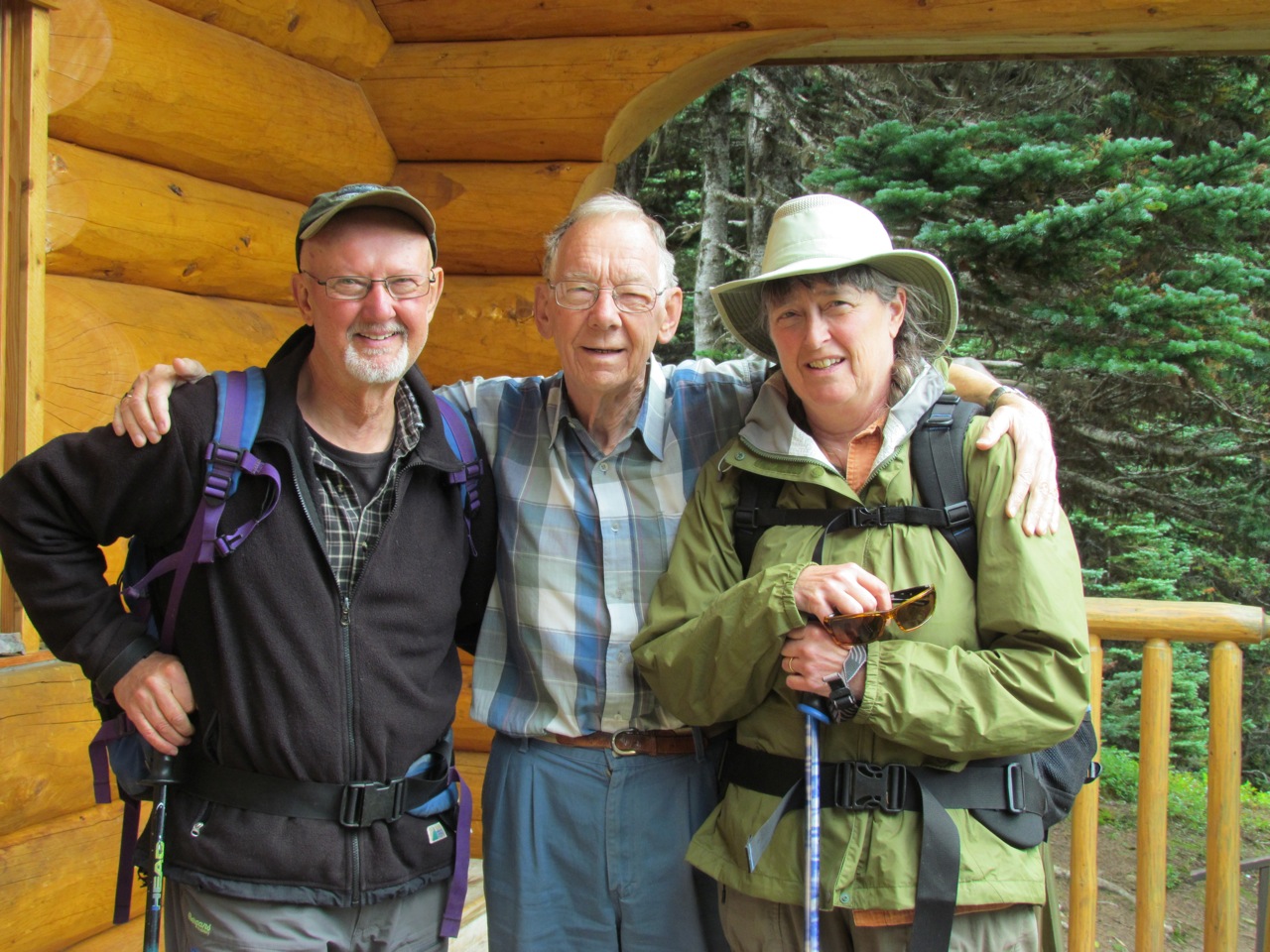
Kristin, (left) Jane Wilde and Lorrie Thompson still quilting together.
Unknown's avatar

Disposition of the Dead*

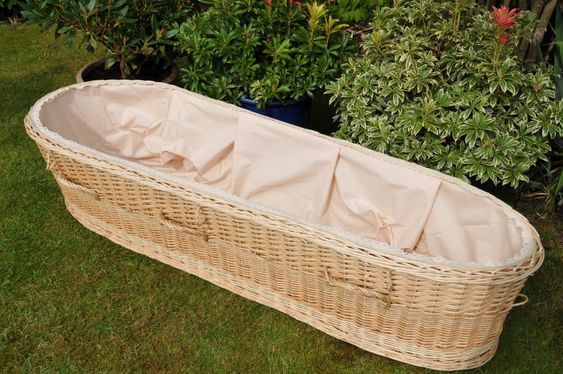
I first came to this topic because Lynn and I were trying to decide what to do. We’d always thought we’d be cremated, but green burials seemed like a good idea and if I’m honest, it was the lovely basket coffin with its cotton bedding we saw on a hospice tour of Stubberfields Funeral Home that really attracted me. So tasteful. So comfortable.

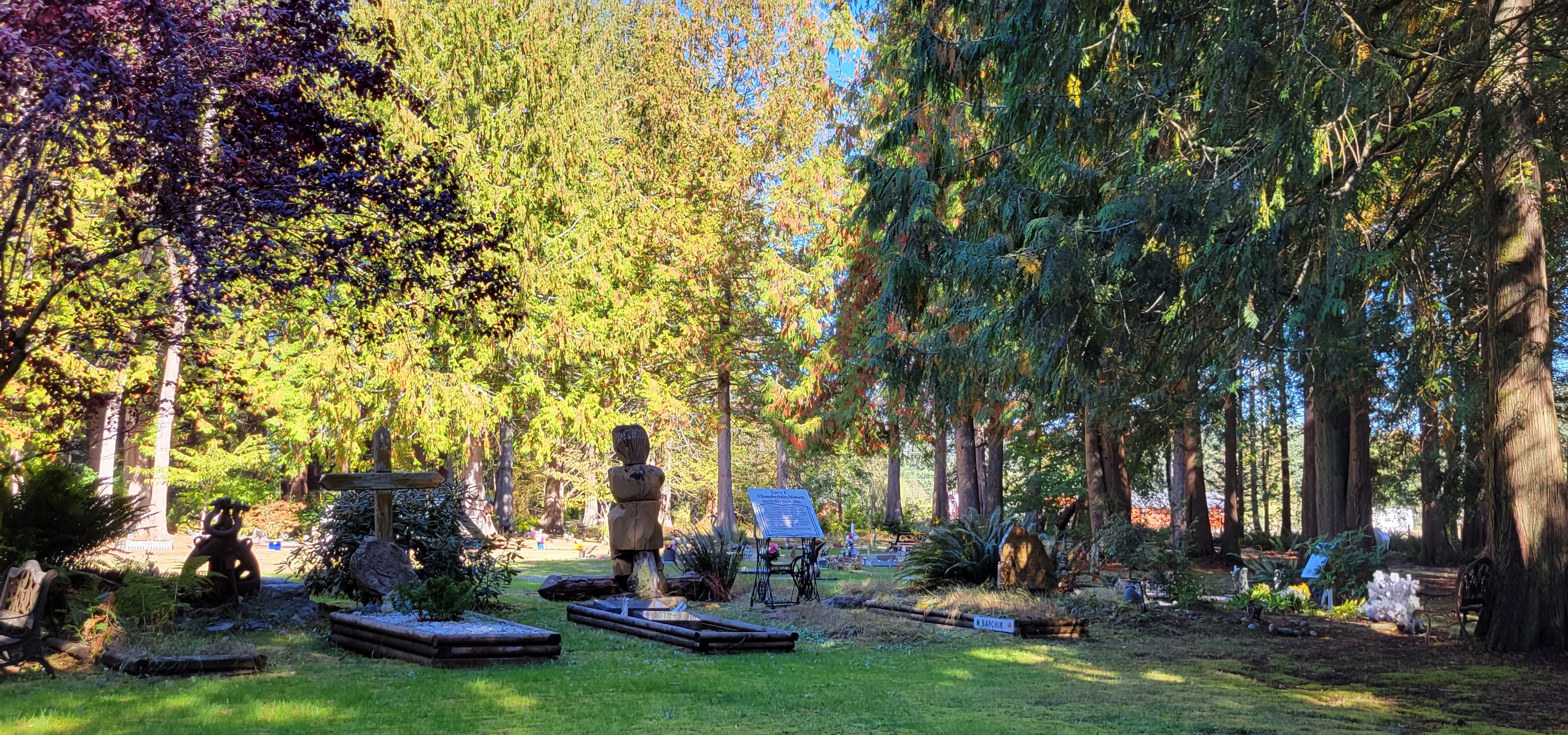
And the Cranberry cemetery is beautiful. A little sedate – not much room for flair – but peaceful and sunny. If we were cremated, we could also go to the Kelly Creek cemetery. It is lovely and crazy. But do our kids want to do something zany to remember us by? It’s not really their style. We’ll have to take them there and see what they think.

The Holy Cross Cemetery on Nassichuk Road in Kelly Creek

While researching this, my mother, who was 99 and in good health, suddenly declined and we were, while mourning her death, busy putting into action her wishes about cremation, burial, and funeral. It brought back lots of memories, or their lack.

When my dad died in 1970, it was very sudden – post-polio syndrome. He was right upstairs when my mom came down to tell us, but I didn’t go to see him. I don’t know why. My brother remembers going. I was in a very strange place. Friends came by and what I mostly remember is I wasn’t wearing my usual mascara and eyeliner. Of course, no one noticed, but I stopped wearing it after that. It seemed pointless. Went back to school within a day or two.

Dad wasn’t cremated until his parents were able to get here from Saskatchewan. They wanted to see him. I think they asked me if I wanted to go with them to the funeral home, but I didn’t. Was he in the church for the funeral? I don’t remember. As I said, I was in a strange sixteen-year-old frame of mind.

I must have had some notion that cremation meant the body disappeared – that there was nothing left. There was no talk of ashes, of burying them or of spreading them. I didn’t think much about it until years later. I asked Mom. She’d left them at the funeral home. He was gone, she said. The ashes held no significance for her. After that Stubberfields tour, I asked the director Patrick Gisle what he did with ashes left behind. I actually wondered if they could still be there, fifty years later. He told me it happens regularly and he has a few quiet places he spreads them.

I suspect Dad’s parents would have liked to bury them in the lovely little prairie cemetery where they’re now buried. There’s something beautiful about the expanse of land and that big prairie sky. Dad might have liked it too. He was at heart, I think, a prairie man. My friend Margaret’s family has a private graveyard in Manitoba, near what’s left of the family farm. On her regular trips to the small town where her brother David lived until his death a couple of years ago, she tends to the graves, which go back at least four generations.  She has a deep sense of attachment to the place and its history. She’s thinking she’ll have her ashes buried there.

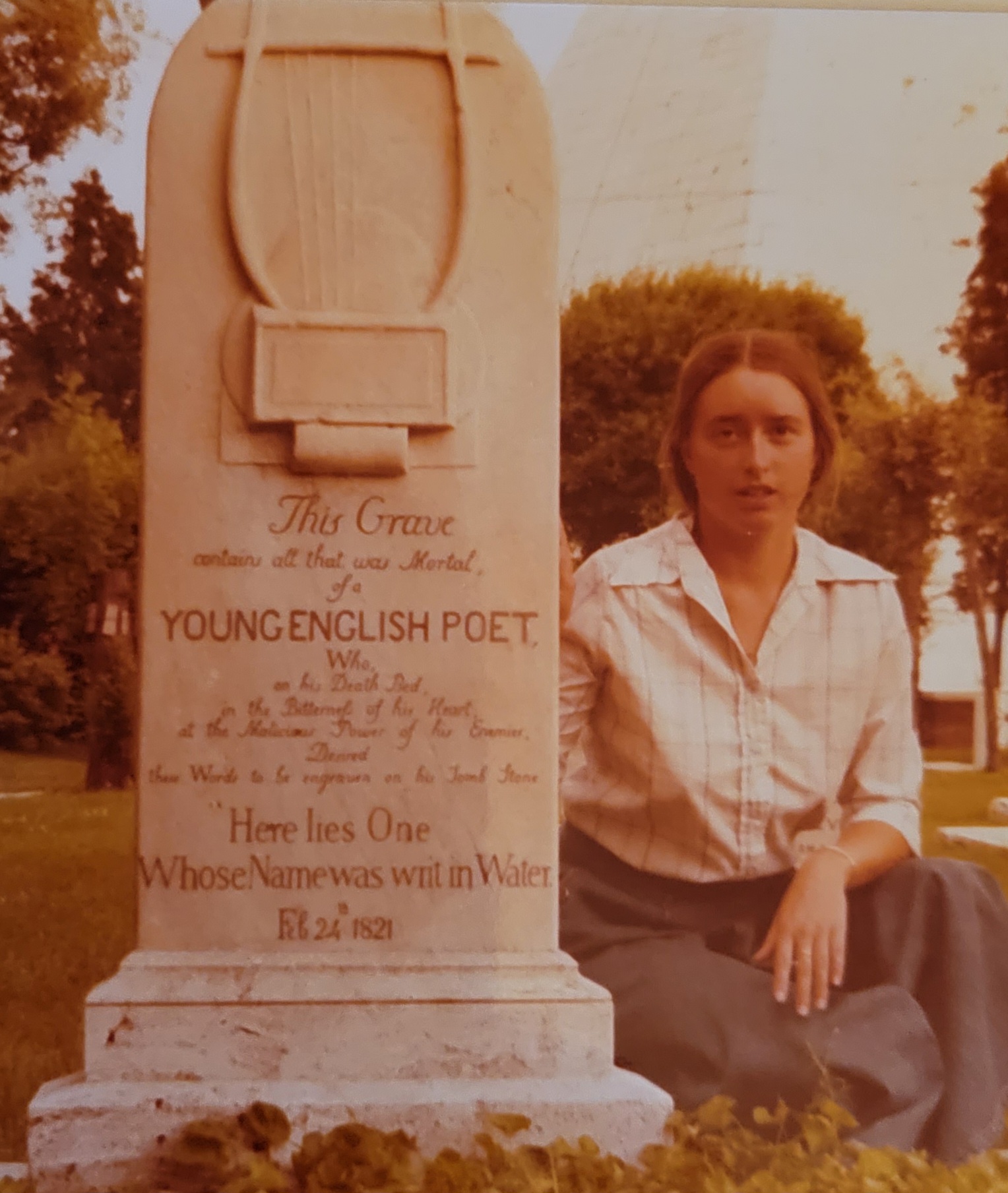
Cemeteries give a kind of permanence to the disposition. They form part of the historical record and can become places of both private and more public pilgrimages.  I remember visiting, in 1977, the grave of the poet John Keats in the Protestant cemetery in Rome just after going to the rooms beside the Spanish Steps where he died of TB in 1821. He was 25, a year older than I was then. I’d been reading his letters. His friend, painter Joseph Severn, described his death: In the afternoon he uttered his last words ‘Severn-I–lift me up–I am dying–I shall die easy–don’t be frightened–be firm, and thank God it has come!’ That night he expired, ‘so quiet’ that Severn still thought he slept. I found myself in tears – so moved by his youth and his generous heart. His epitaph broke my heart: Here lies one whose name is writ in water.

Although tombs can become the focal points of terrible conflict, visiting the graves of celebrated figures connects us to our cultural and religious communities, whether it’s Jim Morrison in Paris or the Taj Mahal in Agra. On a local level, participating in the cremation, the interment of the body or the spreading of ashes connects us on a more intimate level to our family and friends.

The past fifty years, at least in North America and Europe, have seen the creation of rituals to replace the Christian traditions many of us have left behind. Children decorate their grandparents’ coffins, ashes are turned into jewelry or sculpture, spread from helicopters (or in the case of Hunter S. Thompson, shot out of a cannon). Notes are tucked into urns, shrouds are woven by the intended user and proudly displayed, coffins are built in distinctive shapes; a popular example can be used as a bookcase until it’s needed for burial.

To reduce both financial and environmental expenses, Community Supported Dying qathet lends out a handmade and decorated coffin to transport an enshrouded body to its burial site at the Cranberry Cemetery.

Borrowing a Tibetan tradition, we started hanging prayer flags after a trip to Nepal, liking the idea of the wind carrying prayers out into the world, helping us all in the work of practicing compassion, of relieving suffering. The spot we chose on our property near Smithers funneled the wind blowing through from one mountain range down the canyon of the creek we lived beside into the watershed of the Wedzin Kwa and on to the great Skeena passage. I sewed together my mother-in-law’s beautiful hankies in her memory; we made flags out of old linen napkins with poems and blessings written on them. We spread ashes among the willows and aspens facing into the sunniest opening in the canyon walls. We created our own sacred place.

But then we moved. It’s on someone else’s property now.

We hung prayer flags from the lighthouse beside our house at Grief Point, or χakʷum by its ʔayʔaǰuθəm name, but it doesn’t have the same sense of private pilgrimage. The land was alienated in the 1890s and our subdivision was built in the 1960s. Tla’amin artifacts were found during the extensive excavation work, underscoring the ways in which precious places can be overrun, lost.

Cemeteries are perhaps an attempt to keep that sense at bay. My grandma, aunt and soon my mom’s ashes will be buried in Cranberry. My sister has reserved a plot there too. I suspect in one form or another Lynn and I will end up there. Still not sure what form that might take.

Mom and I visited the Cranberry Cemetery just a month before she died.
  • This piece came out of research done for an article by the same name published in qathet Living for its Memento Mori issue in November 2023 and a gathering I led for one of the qathet Art Centre‘s Memento Mori events November 15, 2023.
Unknown's avatar

Knitting socks

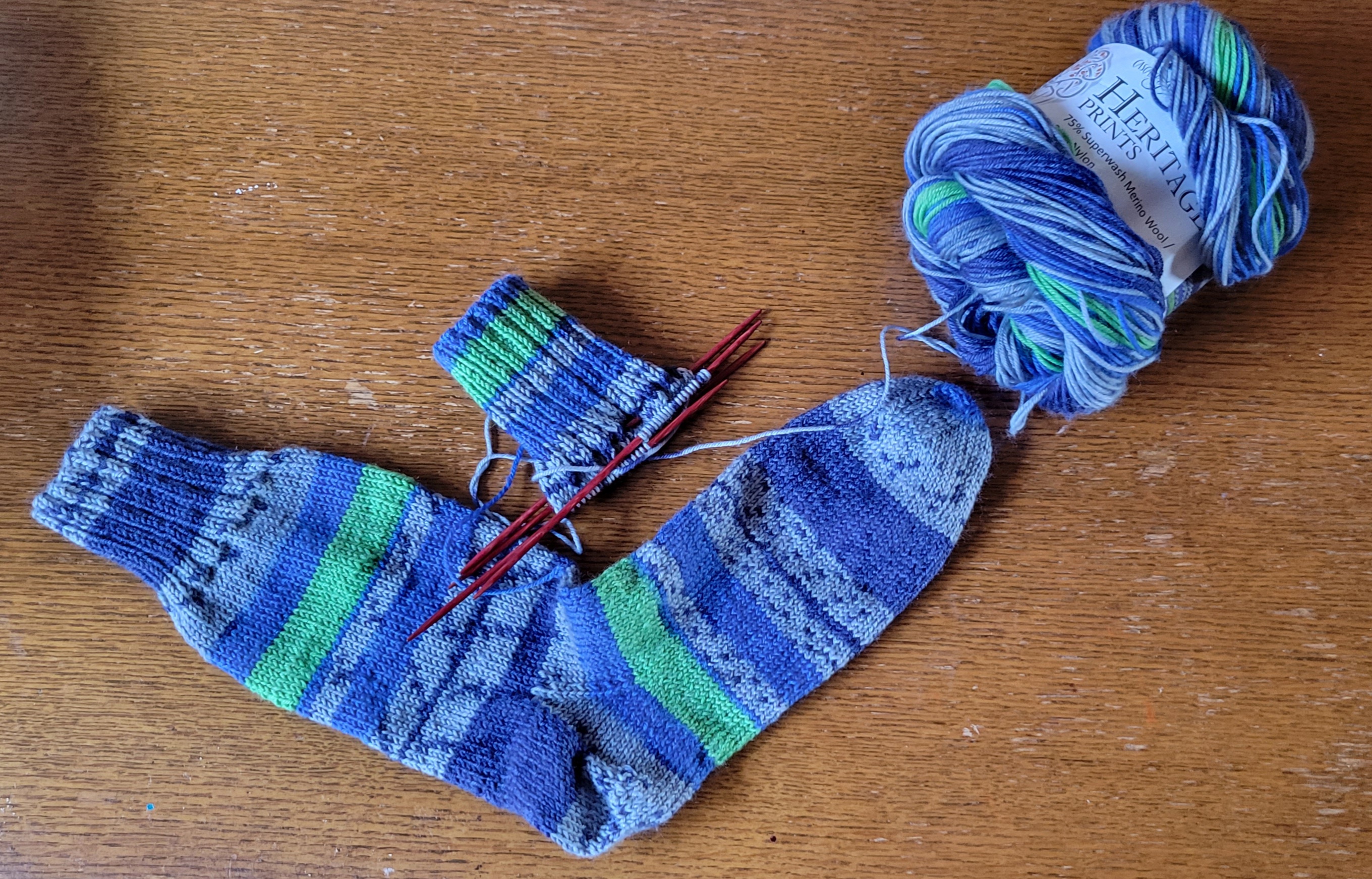
I was in the kitchen I think, when Mom walked in with her old knitting bag. She pulled out a ball of variegated sock yarn and behind that, three needles carrying a tangle of stitches. The fourth needle dangled from their midst. It was heartbreaking. After she couldn’t read anymore, she could still knit. And she did. Socks for her grandsons. But now she couldn’t, not even the socks she’d been knitting for decades. Stitches dropped, yarn carried across the gaps, needles turned so the most important part of a sock, the hole into which you place your foot, was gone. I almost cried. There was so little left.

Just a few months earlier, she was still able to knit if I was nearby. She knew when something went wrong. She knew, but couldn’t see what it was or figure out what to do. I’d take it from her, fix it up and hand it back. Watch for a moment to see she was back on track. Together, we’d also been able to finish a huge blanket she made for one of her grandsons, Chris. She gave it to him just a couple of months before she died. We had so much knitting fun over the years, visiting wool shops, sitting together knitting, talking about patterns.

I just read an Ann Patchett essay, How Knitting Saved My Life. Twice, in which she describes how she’d come back to knitting when travelling in Ireland. When she made a mistake, she’d hand her knitting to any woman who happened to be nearby and ask for help. They could always fix it, she said, and if they had time they’d teach her how to fix it. I remember Lynn, when he was learning and I wasn’t nearby, going into yarn shops and asking for help. Always freely given.

It wasn’t until I was going through Mom’s belongings after she died in September that I came across her sock pattern. She never referred to unless it was time to turn the heel. Over the years, how many times did I hear that phrase, just wait until I’ve turned the heel? It required concentration and careful counting. My heart broke all over again to see the raggedness of the paper onto which the pattern had been glued how many years ago? The pattern calls for P.K. Victory Fingering Yarn and must have dated back to the 1940s, when girls knit socks for soldiers. It refers to Maitland Spinning Mills, Ltd. Listowel, Ontario. A division of Mercury Milled Limited. Hamilton, Canada. She’d likely have knit a few socks back then, for she knew men who were overseas fighting. One, Leslie McLean, whose letters I found in a box tucked away in a drawer in her bedside table, was killed in action in 1944.

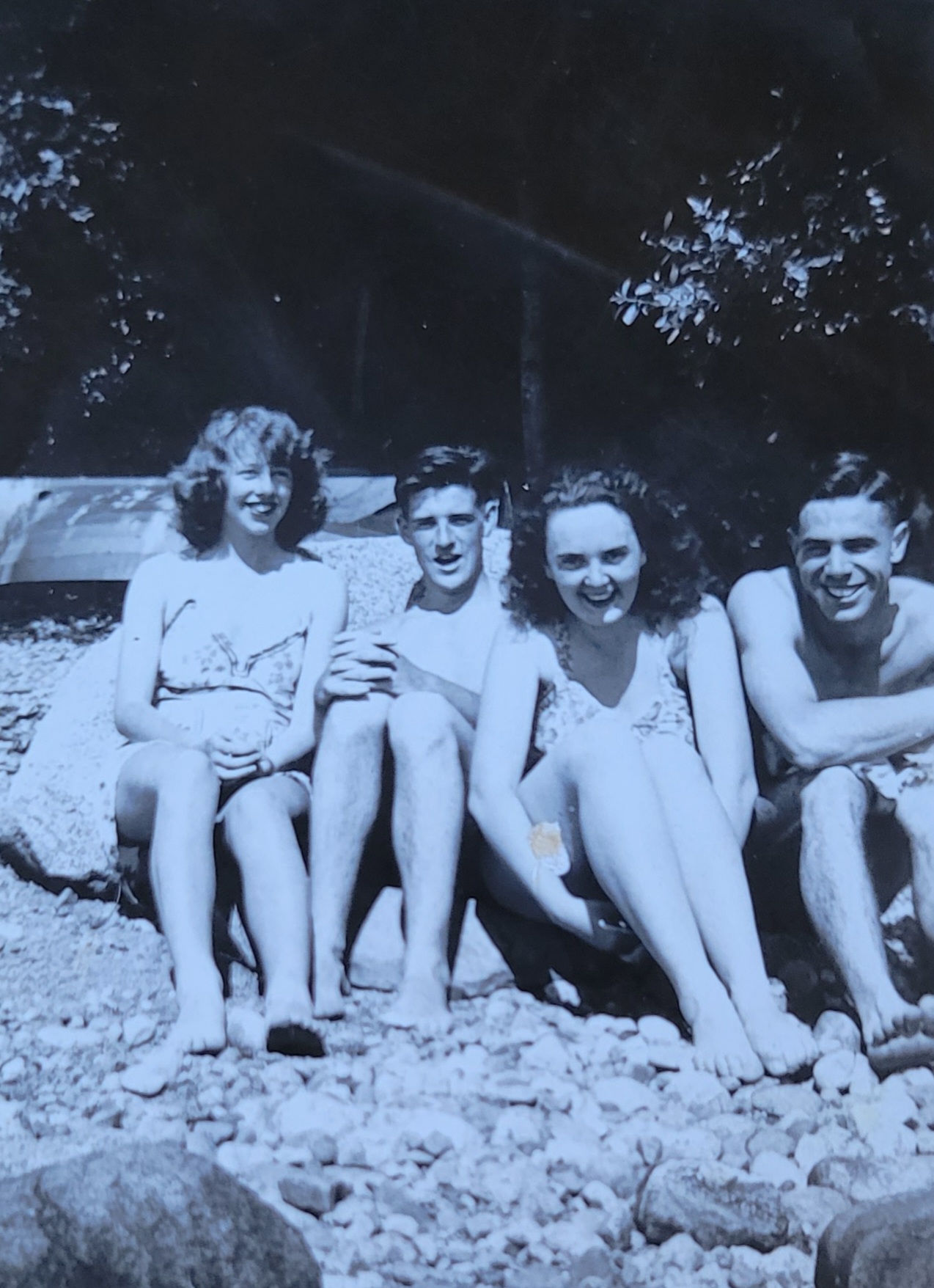
Mom, Leslie McLean, Hilda Nuttall, and Frank Dickson, 1942

I don’t recall her knitting much when I was a kid. My grandma did, and she could make the needles clack, she was so fast. The socks just whizzed off her needles. I tried using her old steel needles and the knitting belt an admirer made for her, but was never fast enough to make them sing.

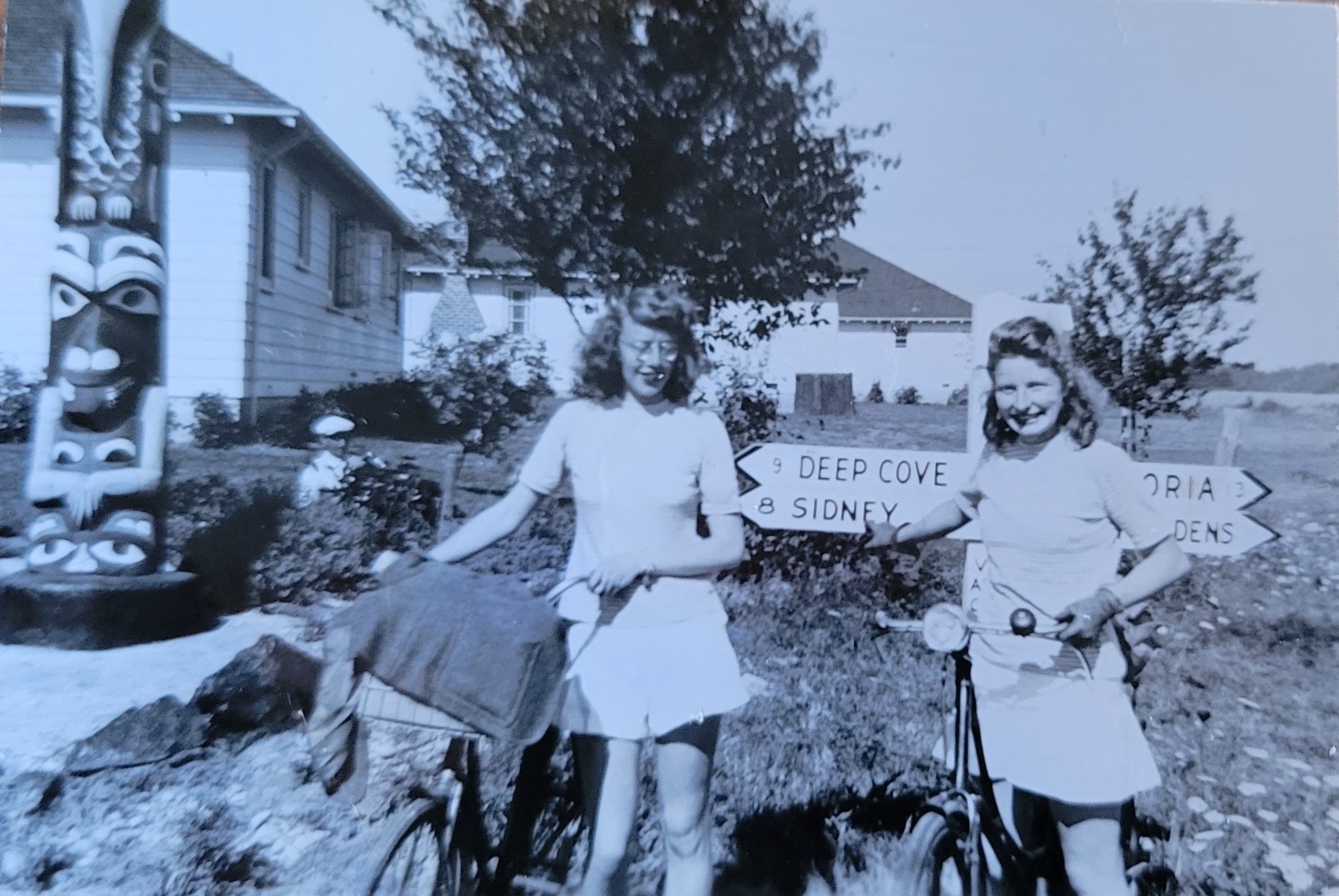
When Mom lived on Vancouver Island in the late 1940s, she and her best friend Flo rode their bikes from Victoria to Powell River. Did they ride them back too? Did they take a Union Steamship across? I never did get the story straight. But for the next 70 years they visited back and forth and exchanged patterns and wool and went out for a Dairy Queen Blizzard whenever they were together.

But just as she lost her sight, she’d lost many of those memories unless you found the right questions to ask. Always tricky, that. Finding the right questions. And now we’ve lost her too.

It’s hard remembering her walking into the kitchen that morning, wanting to knit, and not being able to help her. I feel now, I should have let her knit up that tangle, fixed it as best I could and let it grow and grow. Since I can’t do that, I’ve taken up the wool and the needles a friend gave to her a couple of years ago, and am knitting up the socks, following the old pattern. These are for her great-grandson.

Unknown's avatar

A year of losses

The past few months have been difficult. We’ve lost close friends, all of them much too soon. And during those months, we were also slowly losing my mother. At 99, it wasn’t unexpected. She didn’t have dementia exactly, but she was getting confused and seemed to be spending more and more time deep inside herself. It is, I’ve been told, a characteristic of people who will soon leave.

And leave us she did. One Monday morning in September, she woke up as usual, ate breakfast, walked to the park just down the road, and continued her typical day. When she woke up the next morning, she didn’t want breakfast. Then she didn’t want lunch or her usual rye and water. Or dinner. And that was that. Ten days later, September 23, resting in her bedroom of over 50 years with my sister nearby, she quietly stopped breathing.

As we sort through the markers of her long life – letters, photographs, jewellery, clothes, books – I keep thinking about her. About our lives together and apart. About the last four and half years when we shared a home. Remembering, wondering, and mourning. Feelings I want to write about and will, but first I want to give you a sense of her by sharing the eulogy my husband, Lynn Shervill, wrote for her funeral.

Born on the Shetland Islands north of Scotland in 1924, Elizabeth Malcomson Berger (nee Anderson), or the blonde Viking as her second husband called her, emigrated to Canada with her parents in 1929. The family was sponsored by former North Island MLA Mike Manson and spent their first months in a tent on Hernando Island before moving to Westview. That was 95 years ago, back in the days of the Union steamships. Today, Betty is gone, just shy of her 100th birthday. But her family continues to receive reminders of the impact she had as a teacher on students in her beloved community.

For instance, when Stubberfield funeral home director Patrick Gisle was notified of Betty’s death, his immediate response was ”She was my Grade 1 teacher.” Another time, as Betty and I were leaving the hospital, an ambulance attendant walked up to her and said “JC Hill was the best school I ever went to and it was because of you.” When one of Betty’s care aides arrived at the house a few weeks ago she told us Betty had been her principal at JC Hill. One of her former students, Mike Slade, along with his wife Ulie, was a regular dinner companion. Such was Betty’s career she sometimes taught three generations of students from the same family.

Hundreds, probably thousands, of Powell River young people benefited from Betty’s 40-plus years as a teacher mostly at JP Dallos and JC Hill schools here in Powell River. This would not be surprising but for the fact she had always expected to settle into the traditional role of housewife for her first husband, Saskatchewan farm-boy Herb Peters, and their three children, Susan, Herb Jr. and Sheila. But it was not to be. Herb Sr, fell victim to polio in 1953 and, while he was able to live at home, he was unable to return to work and needed lots of physical assistance. Betty went back to teaching in order to support the family and somehow managed to earn a Bachelor of Education degree through summer school sessions at UBC and be promoted to principal at JC Hill.

Her family were an ever-present support to her and Herb over these years, arranging for the completion of the house Herb had been building on Quebec Street when he got sick, helping sell their little house on Butedale, taking care of the kids when Betty went back to work. Her mother, Kate, kept house for the family on and off over those years and even welcomed the whole bunch of them back into her home when they sold their Quebec Street house in order to build the beautiful waterfront home at Grief Point, a place Betty adored in spite of her father’s warning about building “in yon windy hole.”

Only two years later, Herb’s ability to breathe was severely compromised by post-polio syndrome and he died in his sleep just hours before they were to leave for Vancouver to seek medical advice.

While missing him greatly (she had two teenagers still living at home!), she kept her sense of adventure. Her mother, Kate, was a passionate fan of Robert Service. In 1969 Kate, Betty, 17-year-old Herb and 16-year-old Sheila set out in their 1968 Acadian for Dawson City, 3200 km away, half of it on gravel roads, with communities about 200 miles apart. After a stop in Barkerville to stoke the goldrush fever, they continued north. Herb Sr. must have been watching over them because, although they carried no more than a few snacks assuming they could stop at restaurants along the way, they never went hungry and always found a hotel room. The car did well and Sheila remembers only one flat tire along the way, though they met many people along the Alaska Highway, waiting days for car parts.

Betty survived a couple of years as a single mom of two teenagers still at home before they left for university. A year or two later, a local mill worker and avid reader by the name of Albert Berger came into her life. She wasn’t interested at first, but he was persistent and finally, instead of closing the door on him as he stood in the howling wind on her porch, she invited him in. Albert brought his two adult children, Alison and Lawrence, into the family along with a lot of humour and adventure. They had thirty wonderful years together. He and Betty played bridge, danced at the Beach Gardens, and were members of the Myrtle Point Golf Club. But their favourite activity was frequenting casinos in Las Vegas and Reno. Betty especially liked watching the musical headliners in Vegas and Albert, with his betting systems, was a star at the Craps table. He was such a good gambler that Betty didn’t have to get any cash from her bank for a year after Albert died, she kept finding money in pockets, envelopes, drawers and cupboards as she sorted through his belongings.

Another of Betty’s passions was swimming in the ocean, something she as a child in Shetland and did right up until last year when she went for a dip with Sheila. A couple of years earlier, she tried to talk Alison into joining her. Alison is not a fan of cold water and believes something scary is going to rise from the ocean deeps to get her. “Alison,” Betty said, “There’s nothing to worry about” and dove in, swimming right into a big jellyfish. She flew out of the water with stinging welts over her face and neck. As Alison tended to her, we know she was feeling at least a modicum of vindication.

One of Betty’s favourite pastimes was bridge. She played with both Herb Sr. and Albert and continued on even after Albert’s passing. She admitted she wasn’t a very good player but never, until about two years ago, missed a Friday afternoon game at the home of neighbour June Vogl. Her eyesight was failing and she had trouble hearing. As the months ticked by she was easily disoriented and had memory problems. But up until a month ago she would still sit at the breakfast table and help us with the New York Times crossword puzzle and Wordle, using our verbal clues to divine the correct answers.

Betty was the middle child of five. Her four siblings, two sisters and two brothers, all pre-deceased her but she was able to connect and say goodbye to her children, grandchildren and great grandchildren in the weeks before she died. She was loved by all and we will carry her in our hearts forever.

Unknown's avatar

Seismic events

Talking idly to a friend about the weather, about how today Malaspina Strait is moving north, he asked me if there’d been a seismic event.

It took me a moment.

“Is the strait the physical landform or the water it contains?” I asked.

“Both,” he said.

Okay. The water in the strait is moving north. A southeast wind is blowing.

A few weeks earlier, I’d reread a poem of Pablo Neruda’s from Winter Garden. The Star is the final poem in the book, the manuscript of which was found on his desk after his death under suspicious circumstances just twelve days after Pinochet’s coup and Allende’s suicide.

Well, I never went back, I no longer suffer
from not going back, the sand willed it
and as part wave and part channel,
syllable of salt, leech of water,
I, sovereign, slave of the coast
surrendered, chained to my rock.
There is no freedom anymore for us
who are fragments of the mystery,
there is no way out for returning
to oneself, to the stone of oneself,
no other stars remain except the sea.

There’s much about this poem I don’t understand and much I can only guess at. Its grammar confuses me.  But the lines “part wave and part channel, syllable of salt” stood out when I first read it, and were then echoed in my friend’s observation.

Are we part wave and part channel? Both the body that contains the energy and the energy itself?

Of course.

The deeper question is, are we river or ocean?

In a creek or river, the water moves through the wave created by gravity and obstruction. The wave itself doesn’t move much.

In an ocean or lake, the wave is created by winds or tides. Its energy moves through the water, but leaves the water, momentarily lifted by the wave’s passage, behind.

Which are we?

In Autumn, the poem preceding The Star, Neruda writes of leaving the city in its turmoil and politics:

I fly back to the sea wrapped in the sky:
the silence between one wave and the next
creates a terrifying suspense:
life ebbs out, blood stops flowing
until the new wave crashes on
and we hear the booming voice of infinity.

And, of course, that’s a rich description of the heart pumping blood through our arteries – the stops and starts that, like the individual frames of a film winding through the projector, create the illusion of an uninterrupted flow. Endlessness. Infinity.

Until it stops, the end of the reel flapping in a dimmed movie theatre.

But we are more than a strip of tiny images stuttering in the dark, more than a heart beating out the time of our days. We are wind, we are gravity, we are the obstruction that creates the waves, we are the waves themselves. And for a few years our bodies are the vessels that contain it all.

Unknown's avatar

Knitting a Life – for Gail Jenne

Gail, son-in-law Perry Rath, daughter Taisa and Gail’s amazing, wonderful husband Richard

When the Jennes moved into the house on Park Road, just up the way from our old home on Driftwood Road, we didn’t have any idea how much the family would enrich our lives. We became part of their joyful and sometimes chaotic gatherings and began to create our own family rituals with them – birthday dinners, Christmas tree outings, the hanging of prayer flags, picnics in freezing weather. Morels and cranberries. Rituals that shifted over the years but always re-emerged when visits brought us together.

You all know the many ways in which Gail brought joy to us, but there’s one in particular that I share, I think, with her sister Cathy. Gail would embrace whatever knitted gift we gave her, no matter how kooky it appeared. On Gail, everything looked just right. And so, it is to knitting that I turn to speak of her.

The slip knot that begins a knitting project is a tender thing. So fragile. One tug the wrong way and the knot falls open and vanishes. Tied around a knitting needle, it holds firm. Strong enough to anchor the hundred thousand stitches it might take to make a cozy sweater or blanket. Row by row a thread is pulled through the loop below to add another link, each one a fragile connection with the ones on either side, the ones before and the ones after. An exercise in hope, in trust. The shape emerges from the increases and decreases, the gaps for lace, the layers for cables, each pattern a unique collection of twists and turns and colours brought to vivid life by the knitter.

So it is at birth. When we emerge from our mothers to become air breathers, we are anchored, finally, into our own bodies, and begin the process of creating ourselves. Each breath we take, the air pulled in, looped through the blood vessels of our bodies, and pushed out again, is like one of those knitted stitches. All the breaths knit together into a life. One long cord miraculously ravelling us up into the bright and beautiful garment we each become.

And just as the umbilical cord was cut at our beginning, so is the breath that tethers us to this world cut at the end. Gail, now that your wonderful lungs that filled so many hearts with their beautiful music, after maybe half a billion breaths, are at rest, we will miss you in so many ways. You may no longer need that unique garment you threaded together for us, but its shape, its colours, its memories will remain in all the hearts you’ve touched.

Love you girl! Have a wonderful journey. And if you’re able, maybe drop us a line from time to time.

As for us, we’ll be listening to that Green Grocers CD for as long as we last.

Lynn and Sheila

Unknown's avatar

Driftwood, circling back

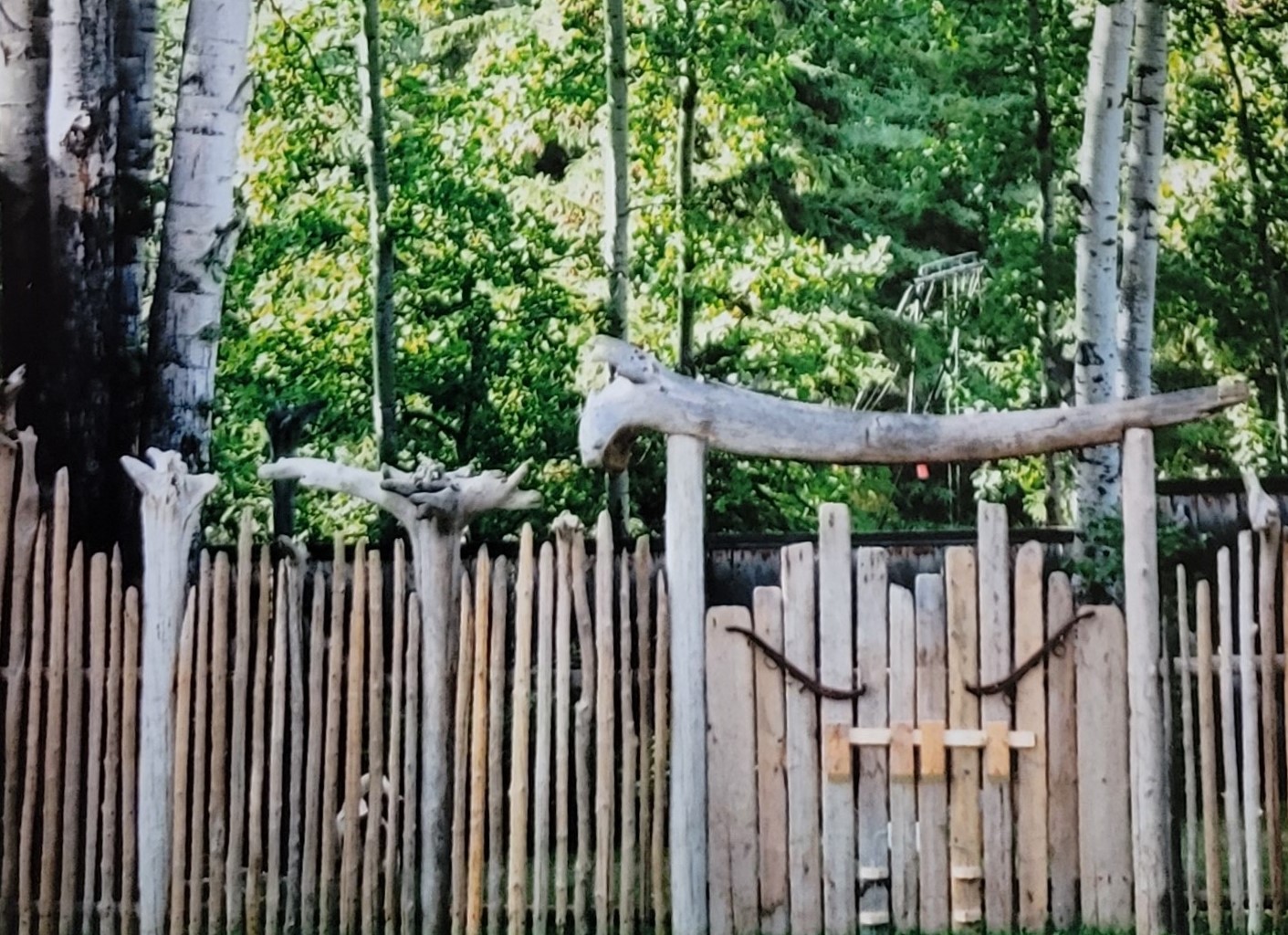
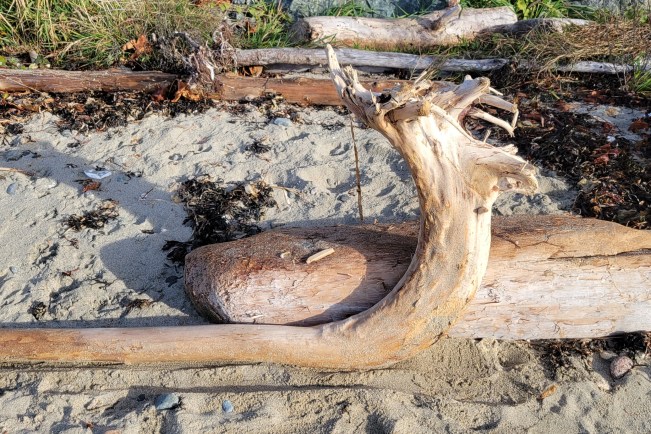
Folks who live in seaside towns are very fond of driftwood. Driving along coastal roads you see artful root clusters displaying house numbers. Flowerbeds are bordered by curving logs, fences constructed from salt-weathered timbers. It inspires us to rearrange our small domestic landscapes to display its surprising shapes, to fill its cavities with garden ornaments or tiny succulents. In a small way, it illustrates our desire to bring the wild, the feral into our domestic spaces.

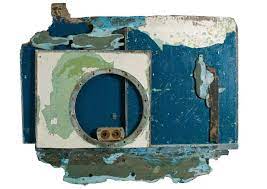
In his wonderful book, Wildwood: A Journey Through Trees, Roger Deacon’s chapter on driftwood begins with a climb up the stairs to Margaret Mellis’s studio in Southwold, one of the most easterly English communities on the North Sea coast. Towards the end of her long career, she began to create objects out of driftwood. Deacon writes:

Bottom of the deep blue sea
Ribbed

Everyone in Southwold used to bring the driftwood harvest of their beach walks to Margaret’s doorstep, leaving it in the front garden for her. The best of it would find its way upstairs to the studio, where Margaret separated the painted from the natural wood, the former bleached and muted by the sun, the latter chamfered, flayed or shattered by the sea.

Deacon, who also wrote Waterlog, an actual log of his year of wild swimming in Britain, comments on the relationship between Mellis, the water and the wood:

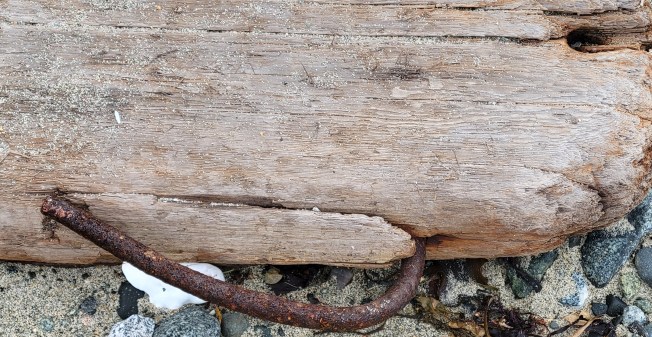
As a sea creature herself, in that she was a regular swimmer, Margaret Mellis felt a natural affinity with driftwood. She took part in its life and knew what it was to float in the tidal currents off the Suffolk coast. Over time, water imparts an abstract quality to wood by sculpting away its inessential, softer parts, emphasizing the sinews of grain until the knots stand out like inset pebbles. Driftwood maps the movement of water around it in its own grain.

The forces that bring it to our shores are often equated with violence and rage. The same power could be said to embody the great eureka moments of love, joy, understanding – likely why we are so invigorated by standing at the shore, sucking in that turbulent air, filling our blood with its chaotic energy.

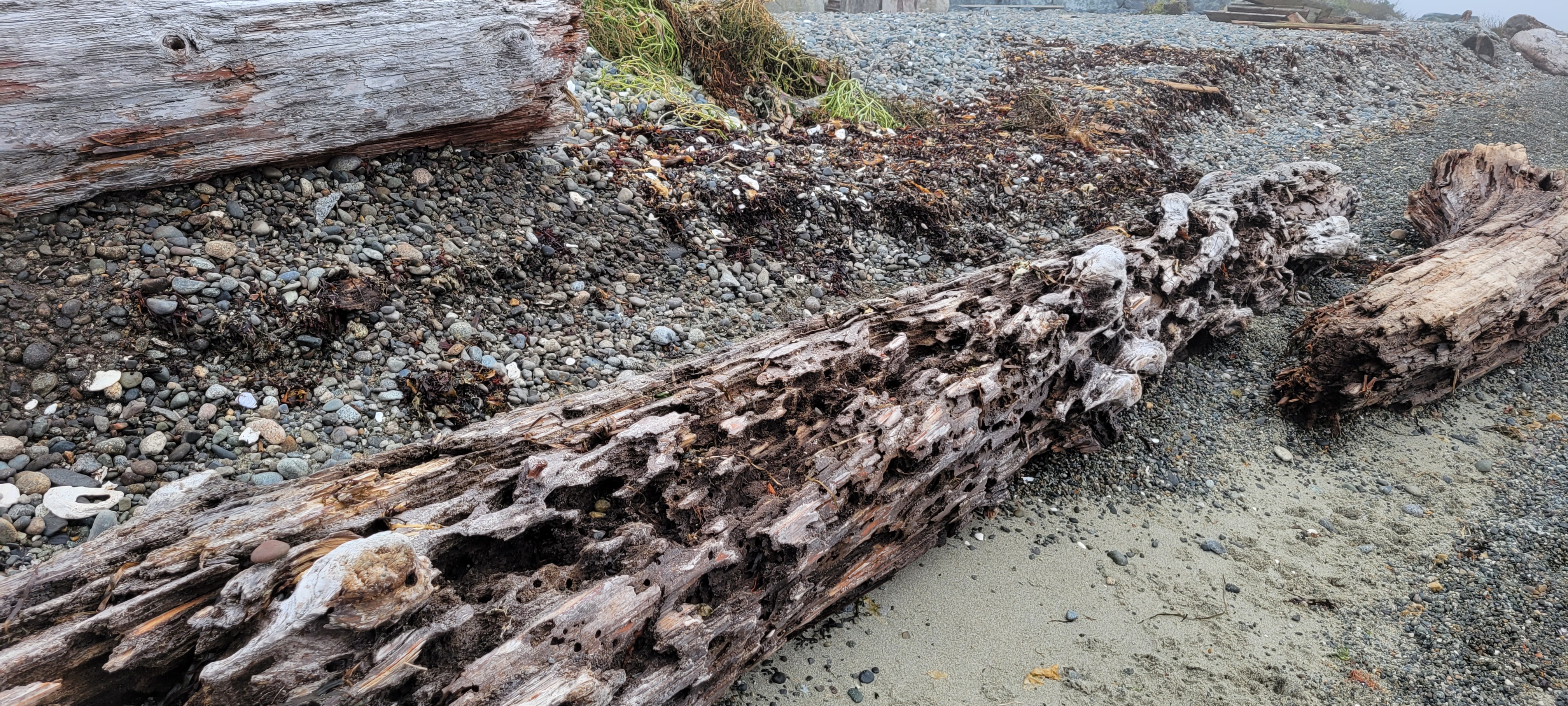
Deacon compares how important driftwood is to the ocean’s ecology to the pivotal role fallen trees play in the life of the forest. Their structures provide shelter for small animals and birds, their decay provides nutrients for all kinds of creatures. Sea and shore birds love it, ride on it, flip over the smaller bits in search of food. In the sea, small clams like the Teredo navalis or shipworm and crustaceans like the gribble worm break down the wood. Their chewing produces sawdust which adds nutrients to the ocean environment. Far from shore, small fish will congregate around driftwood because the microbes and worms it harbours provide food and shade. In turn, the small fish attract larger ones to feed on them.

Even a tree, which we think of as a fixed point, rooted as anything can be to a single place on Earth, can be imagined into a drifting nomad, nibbled by fish, wandering the oceans, ending up anywhere from Southwold to a remote beach on Hokkaido.

Or on a qathet* beach. Remote by some standards, I guess. The larger pieces that get lodged into the edge of the terrestrial world, often, in fact, protect it from the battering winds and tides. They provide very handy back rests, something to sit on or duck behind when changing out of a wet bathing suit. Children run, balancing, along their lengths, jumping from one to the next in a kind of beach parkour. I remember riding logs as a child when the warm southeasterly summer winds stirred up the water and set them afloat.

In her final years, driftwood gave Margaret Mellis a whole new way of working. It connected her to the physical place she lived and to its people. It also gave that community a way to show respect and appreciation by contributing to her work.

Whether we travel the world, or settle, wedged into a refuge of sand and blackberry vines, we are like driftwood thrown loose in the spring freshet, the rush of laughter and sorrow that make up our lives. We are everything we’ve experienced, and even as we diminish, shrink and fail, we’re returning all that we’ve been back to the world around us. We’re returning home.

*qathet is a name given to the regional district (formerly Powell River) by the Tla’amen people. It means working together. Many regional organizations have adopted this name.

Unknown's avatar

Driftwood turned loose

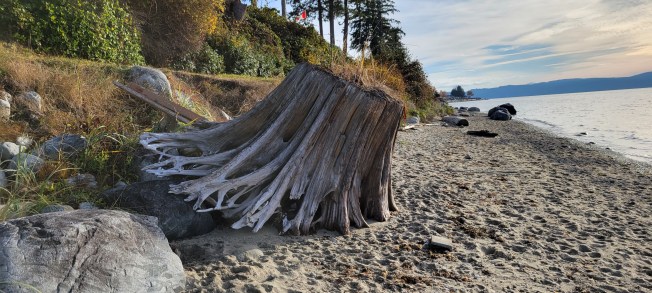
We’ve had a couple of good blows in the last few weeks along with high tides – 17.7 feet here at Grief Point, which is as high as we’ve seen it. Luckily they didn’t coincide. The wind and the tides. Still, everything has shifted. Hundreds if not thousands of logs moved northwest up Malaspina Strait over the past month. Sometimes whole trees, root clusters and branches taking the shape of mysterious vessels. Sometimes a seagull riding.

Walking our usual stretch of beach is like opening the pages of a new book – pages shining with unexpected images, mysterious conjunctions, peculiar stories. Twisted plots expose deep roots, once hidden. Massive logs block stone stairways. Oyster catchers mine the seaweed, tumbled into heaps along the tide line. The peculiar kale plants that grow in the gravel are freshly salted. Still growing.

Driftwood. Having lived for over forty years on a road named Driftwood beside a creek with the same name has focused my attention on the stories those jumbled piles contain: the seed that germinated, the soil that received it, the sunlight it processed into stems and leaves and bark, the years it witnessed, the creatures that climbed it, rested and nested in its branches, the music the wind played in its foliage. There, in Driftwood Canyon, it all originated within the few miles between the creek’s alpine beginnings and our home.

Here, beside the ocean, the whole coast sends driftwood our way. Some trees ripped out by wind, erosion or machinery. Straight cuts on the huge ones tell another tale. Men and chainsaws. Trucks on precipitous roads. The big boom logs, holes at either end to tether the others. The ones that escaped. Then there’s the lumber – wood that could have travelled the world before it arrived here. A boat torn apart in a storm, construction garbage tipped down a bank, a summer cabin bulldozed onto the beach. Decorative fences, seashore patios for viewing the sunset, washed away. The bottom step of a stairway suddenly a chasm.

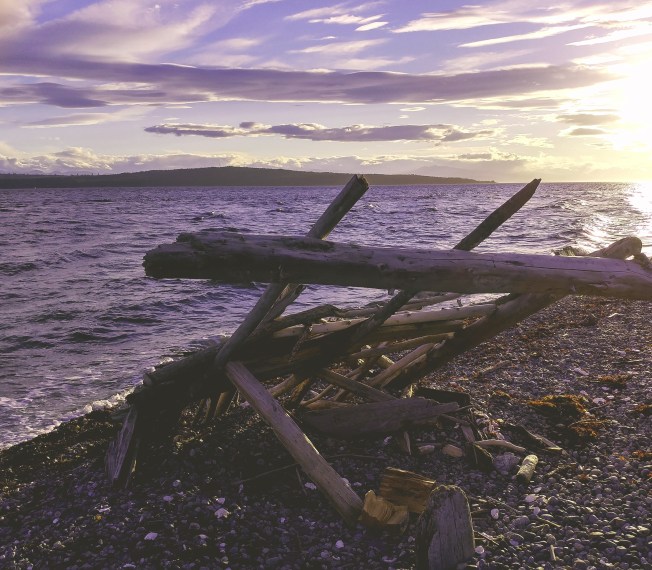
Children build forts with it all.

For each scrap of wood, there was, somewhere, sometime, a tree. That one in the forest everyone questions. Whether or not we heard it fall, that scrap of cedar or Douglas fir contains hundreds of years of stories. The composting berries birds deposited in its canopy. Globe-travelling rain dripping nutrients through the lichens dangling from high branches. Traces from the salmon carcass a grizzly brought inland to share with its cubs. Calcium from the shells seagulls dropped. Everything on the forest floor adds its own note to the song the tree sings. A pile of grouse feathers flung from the owl’s roost. A mouse skeleton under an alder leaf. Someone’s old leather glove decomposing under the moss. A forgotten sandwich. A dog, lost.

Its stories are like the ones languishing in folders in my desk. Some abandoned under a tangle of blackberry vines. Others unfinished. Just resting for a few days, weeks or months until the wind and water, stirring my imagination, set them free again.

After the big wind and tides, the sand is packed hard for pleasant walking and the beach is a library made new. Old favorites, brought out and dusted, seen in a new light. New arrivals, waiting for our imaginations to open them up and make their stories part of our own.

Unknown's avatar

Pausing for the solstice

Grief Point

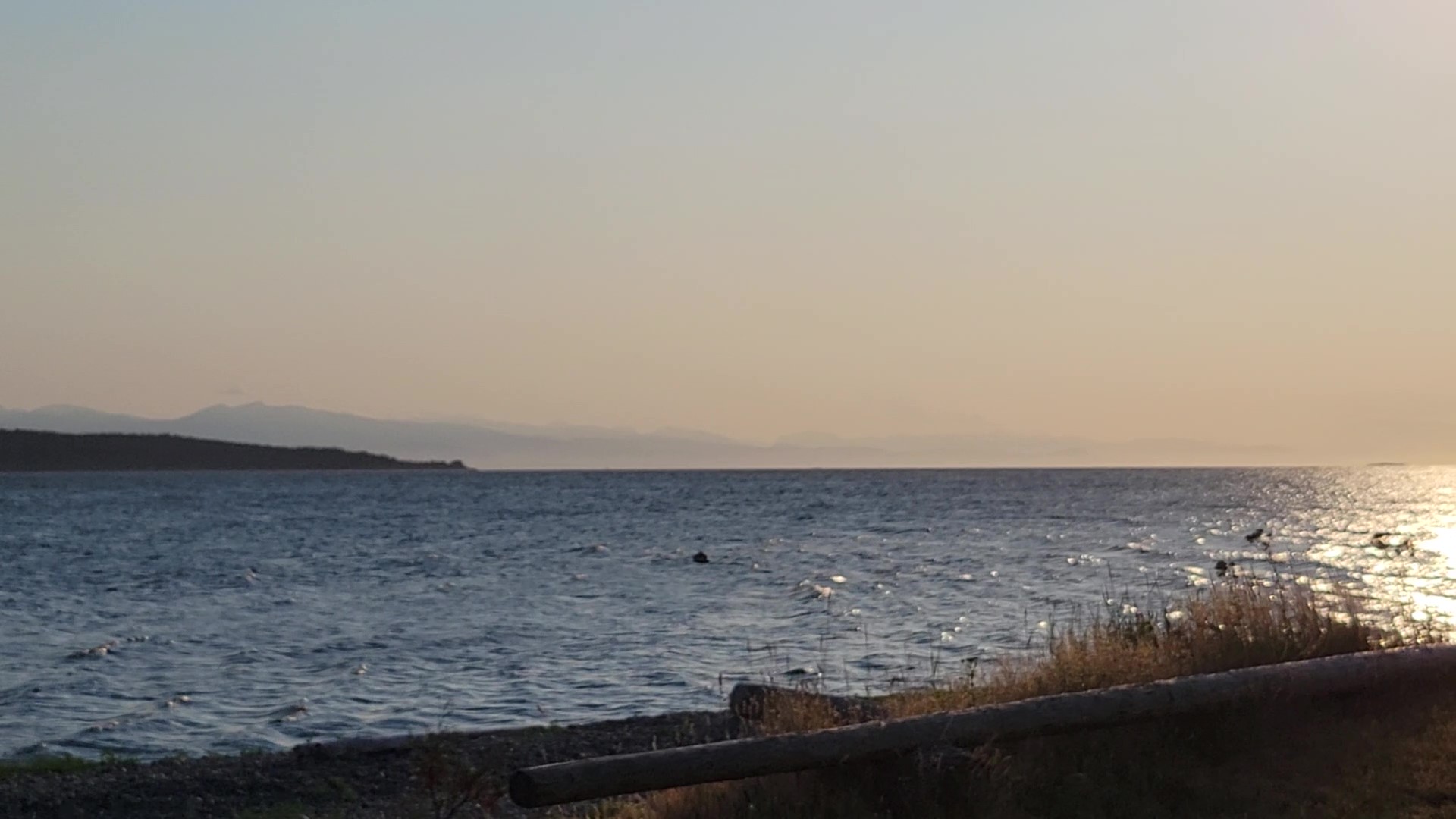
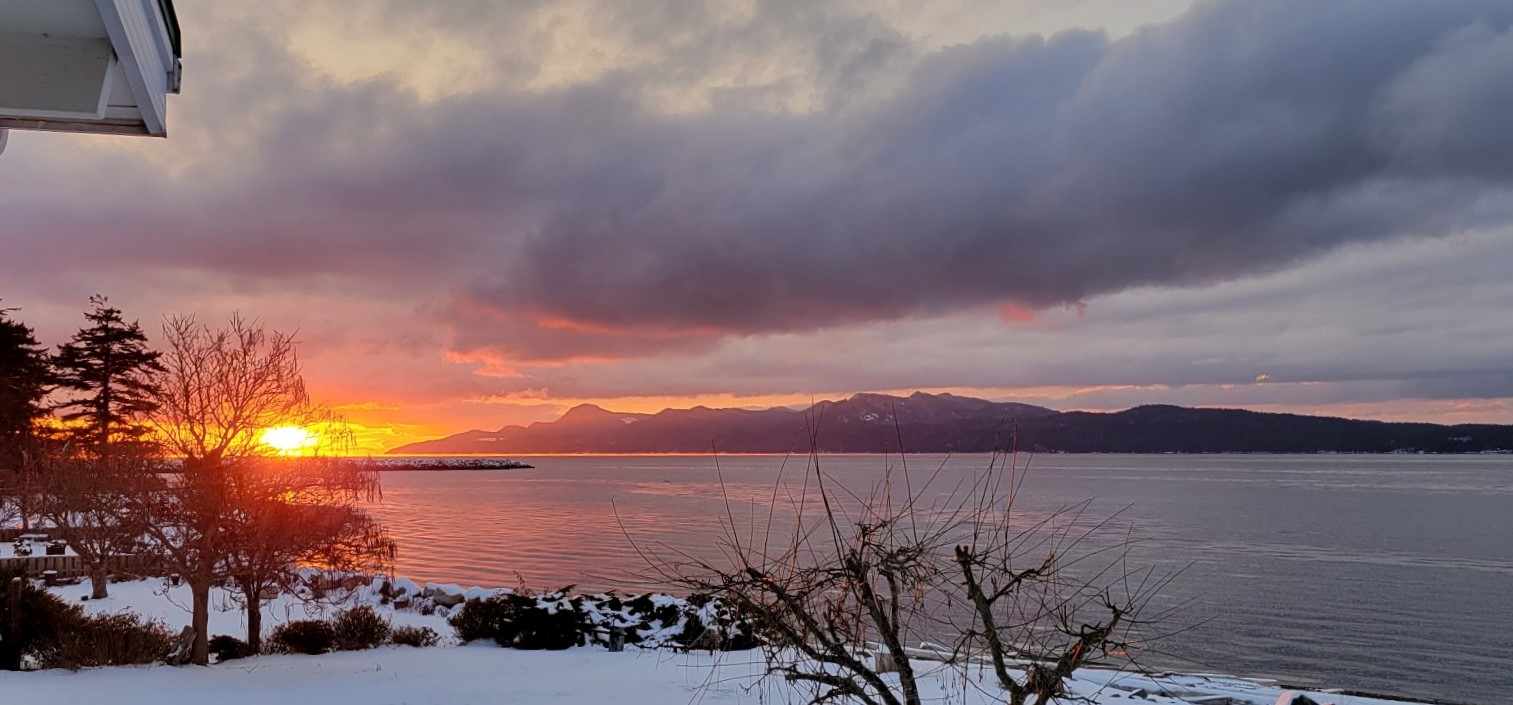
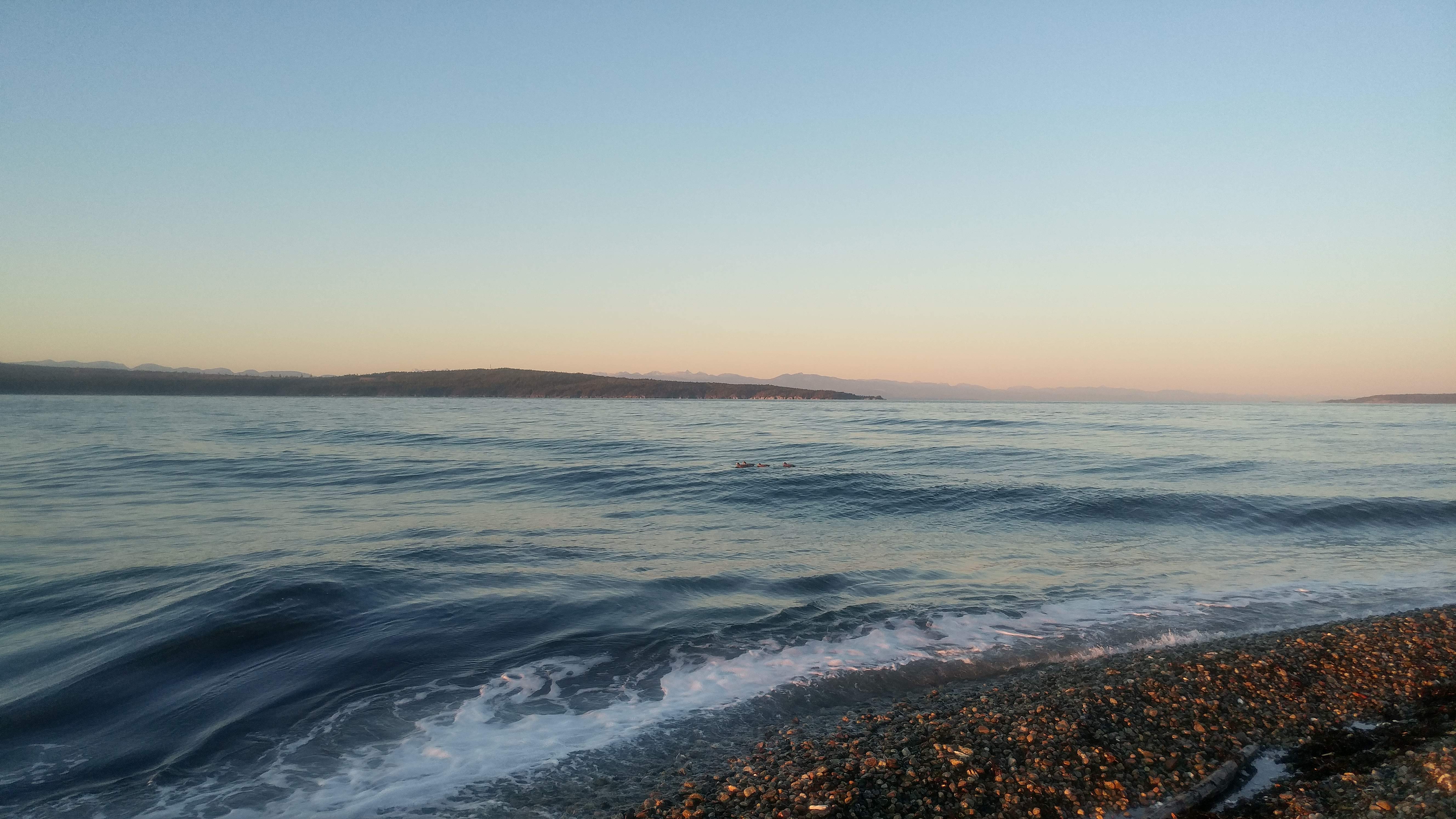
Suddenly, sunrise. Light streaking across the water, a moment of colour and then the silver of mercury. All these shrinking days, the light angling lower and lower, the water turning and turning under the sky as if alive with creatures stretching their bodies toward the light. A living layer of sinuous and sensuous curves catching the brief brightnesses under winter clouds.

Trying to make sense of it, to see the patterns, takes a lifetime. They mark the trajectory of the planet itself, rolling under the great rising and falling wave of the tides. The tug of the sun and moon. The currents. The wind. Often right here, creating a hullabaloo in the downpipes, on the water.

Occasionally distant winds set waves down the fetch to come ashore, noisy where the flags hang limp. The turn of the point itself, an obstacle with submerged diversions, creates eddies and refractions.

Sometimes a layer of water moves across the ripples, a smooth, flattened line tracing some invisible trajectory, some invisible desire, some secret momentum. A stream crossing the currents that pull the strait in its customary path.

And then there’s a moment when it all stops. The water and the shore sit side by side in the great theatre we inhabit, one as calm as the other, unruffled. And you look through to pebbles as clear under the water as they are under your feet. A sea lion rises, rolls over and slips back under. A harlequin tucks it head and dives, a neat little plop. Ripples. All light, marvelous light and the shadows it creates. Movement and silence.

Unknown's avatar

Harry Kruisselbrink, a wonderful friend and mentor (March 31, 1941 – May 2, 2022)

Lynn (L), Harry and Sheila at the Joe L’Orsa cabin in Silverking Basin.

When I arrived in Smithers in 1977 to begin work at the Interior News, one of my tasks was to report on council meetings. Among the colourful cast of characters sitting around the table was a low-key man named Harry Kruisselbrink. Always prepared with impeccable research and clear thinking, his quiet voice cut through the bluster and impatience of larger and more powerful men.

As well as welcoming a new reporter to the community, Harry also welcomed me and my soon-to-be husband into his and Audrey’s home. I remember watching Lynn’s forehead break out in hives after he put too much oelek sambal on his nasi goreng, the Indonesian dish Audrey made for us. Oelek sambal is still a staple in our house. Audrey also gave me good advice about transplanting seedlings, and I think about her every time I pour water over the roots of a tomato plant or petunia before piling on the dirt. Harry took photographs of our family over the years, as he did for many others, and on many a New Year’s Eve we sat at their table to enjoy olie bollen, watching the children grow, the grandchildren arrive.

Harry, always an avid photographer, took this picture of Audrey and their kids (Leroy, Juanita and Charmaine) with us in our newly-acquired back yard in Driftwood Canyon in 1977 or 1978.

Harry’s partnership with Joe L’Orsa began a long connection between the locals and those of us newcomers who wanted to protect what we all valued about the Bulkley Valley. Lynn had coffee almost every morning with Harry during the years he worked at Interior Stationery and the Telkwa Foundation and we worked together on many environmental campaigns to save the Bulkley from Alcan’s plans to re-route upstream rivers, to protect the Babine Mountains, to stop Telkwa’s coal deposits from being exploited.

His keen interest in history got him to conscript Lynn to write the seminal history Smithers, From Swamp to Village to celebrate the town’s sixtieth anniversary. Harry provided many of the photographs.

Harry also played a pivotal role in my fledgling forays into writing. My first published short story featured a young man delivering telegrams, a job that gave him a window into the secret life of a small town in the fifties. I tried to create a sense of Smithers back then, how the railway and the telegraph lines it carried were at its centre. Harry’s willingness to share his own work experiences grounded that story and taught me much about place and connection, how apparently unrelated events draw people together or set them apart in ways we might never imagine.

The collection of short stories in which “Delivery” was published illustrated the environmental link further. Efforts to slow down logging in important habitat resulted in a visit from a Montana economist; he talked about how small towns were often torn apart by resource extraction projects that come and go, leaving the locals Tending the Remnant Damage. Harry took the cover photograph.

Research for more stories led to many conversations in Harry’s office in the old CN station (now Trackside Cantina) surrounded by the walls of batteries, wires and flashing lights used to run the CNCP telecommunications network he helped maintain. One of the central characters in Shafted, a mystery published in 2014, combined Harry’s love of the outdoors, his environmental ethics and that deep rootedness in the town with his past as a telegraph delivery boy.

I need to say that the characters in my stories are nothing like Harry, but his willingness to share his own past gave me a great gift to build upon. Harry never seemed to worry about people thinking he might have been thinking my characters’ thoughts. In fact, he seemed tickled by his contribution.

Harry with our son, Michael, and Richard Overstall, another long time member of the cohort of environmental activists in the region who worked beside First Nations in their fight for justice. Pat Moss, who took this photograph at the launch of Shafted, is another.

Over the years Harry continued as a friend and a strong voice – always willing to say what he believed with clear evidence for those beliefs. He brought that clear thinking and tolerance for disagreement to the last Creekstone Press project we worked on together. Shared Histories: Witsuwit’en-Settler Relations in Smithers, British Columbia, 1913-1973 feels like a bookend to Swamp to Village. Harry was part of a committee that worked with the author to present another kind of history by connecting Witsuwit’en stories to those of the town’s settlers. Harry’s memories of Smithers through his own long residence and his patience and understanding as we all struggled through a very difficult process was integral to the book’s completion. Plus he was the best damn proof-reader an editor could ever hope for.

It seemed especially fitting that the book’s author, Tyler McCreary, was the grandson of one of the councillors sharing the table with Harry back when I began reporting.

The people who love Harry and have benefited from his contributions come from all parts of the community. His example of how to live in a small town, how to bridge our differences, brings us all together. We will miss him terribly.